
What Weight Loss Programs Have Good Long Term Results?
What Weight Loss Programs Have Good Long Term Results?
Very few weight loss programs have published results past 12 months at all, and among major commercial programs only Weight Watchers and Jenny Craig had randomized trial evidence at 12 months or longer showing greater weight loss than control — the finding of a systematic review of commercial programs in Annals of Internal Medicine (Gudzune et al., 2015 [https://pubmed.ncbi.nlm.nih.gov/25844997/]). What predicts durable results is not the brand but five structural features, and you can check for all five in a single consultation.
Dr. Michael Temkin, DO, a board-certified internal medicine physician with more than 25 years in practice in San Ramon, California, runs the LeanMD medical weight loss program at Temkin Health, where the maintenance phase is scheduled to run 12 months after active weight loss ends.
Key facts about long-term weight loss results
- Most program evidence stops at 12 months. The 2015 Annals of Internal Medicine review [https://pubmed.ncbi.nlm.nih.gov/25844997/] found many commercial-program trials ran under a year, with high attrition and no blinding.
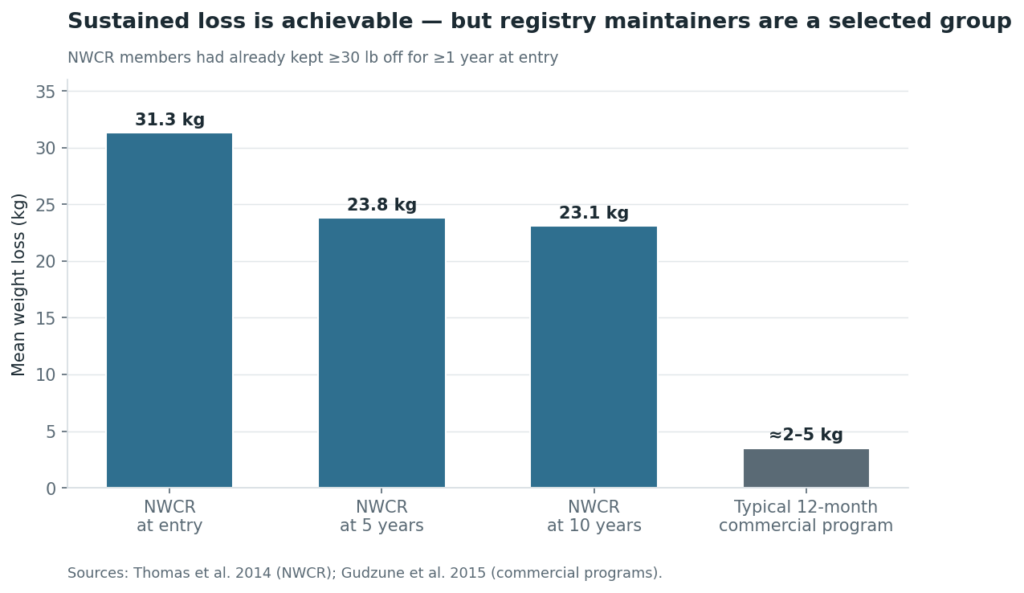
- Sustained double-digit loss is real but structured. National Weight Control Registry members averaged 31.3 kg lost at entry, 23.8 kg at 5 years and 23.1 kg at 10 years, with over 87 percent still holding a 10 percent loss at both marks (Thomas et al., 2014 [https://pubmed.ncbi.nlm.nih.gov/24355667/]).
- Contact frequency tracks with outcomes. The USPSTF [https://www.uspreventiveservicestaskforce.org/uspstf/recommendation/obesity-in-adults-interventions] found 12–26 sessions in year one produced about 6 percent weight loss, versus 2.8 percent below 12 sessions.
- Medication results reverse without a transition plan. Two-thirds of lost weight returned within a year of stopping semaglutide in the STEP 1 extension [https://pubmed.ncbi.nlm.nih.gov/35441470/].
- Lean mass loss is the mechanism behind regain. Across GLP-1 trials, lean tissue has accounted for roughly 15 to 60 percent of total weight lost; the STEP 1 substudy sat near 45 percent (Neeland et al., 2024 [https://dom-pubs.onlinelibrary.wiley.com/doi/10.1111/dom.15728]).
- Protein plus resistance training changes that arithmetic. At 2.4 g/kg/day protein with resistance training during a ~40 percent energy deficit, participants gained about 1.1 kg of lean mass (Longland et al., AJCN [https://ajcn.nutrition.org/article/S0002-9165(22)06559-5/fulltext]).
Why This Question Is Hard to Answer Honestly
Long-term outcome data on weight loss programs is scarce, and the scarcity is itself the most useful finding. When Kimberly Gudzune and colleagues at Johns Hopkins systematically reviewed the evidence behind major commercial weight-loss programs for Annals of Internal Medicine in April 2015, they concluded that clinicians could reasonably refer patients to Weight Watchers or Jenny Craig on the strength of trials at 12 months or longer. Nutrisystem showed promising short-term results but lacked long-term evaluation. For most other programs, the long-term evidence simply did not exist — and the trials that did exist were frequently short, high-attrition and unblinded.
So a program advertising “proven long-term results” is making a claim that, for most of the industry, no published trial supports. That does not make every such program ineffective. It means the honest way to evaluate one is by its structure rather than by its marketing, because structure is observable and outcome claims usually are not.
What the Maintenance Data Actually Shows
The best available picture of long-term success comes from the National Weight Control Registry, which has tracked more than 5,000 adults who lost at least 30 pounds and kept it off for at least a year. Registry members averaged a 31.3 kg loss at entry, 23.8 kg at five years and 23.1 kg at ten. More than 87 percent were still maintaining at least a 10 percent weight loss at both the five- and ten-year marks.
The registry is self-selected. These are people who already succeeded, not a random sample — so it does not tell you the odds. It tells you what success looks like when it happens, and the profile is consistent: roughly an hour a day of physical activity, a lower-calorie and lower-fat eating pattern, regular breakfast, an eating routine that does not change between weekdays and weekends, and frequent self-weighing, with more than 44 percent weighing daily.
The registry also identifies what precedes regain: falling physical activity, falling dietary restraint, less frequent self-weighing, and rising dietary fat. Those four are the leading indicators, and they are all detectable at a routine appointment months before the scale moves.
Where Medication Fits in the Long-Term Picture
GLP-1 receptor agonists changed what short-term weight loss looks like. They have not, on their own, solved the long-term problem. The STEP 1 trial extension followed participants for a year after once-weekly semaglutide 2.4 mg was withdrawn: having lost 17.3 percent of body weight, they regained 11.6 percentage points, finishing 5.6 percent below their starting weight, and most cardiometabolic gains drifted back toward baseline.
The mechanism matters more than the headline. Rapid weight loss removes lean tissue along with fat, and lean tissue is metabolically expensive to maintain — losing it lowers your resting energy expenditure so the eating pattern that used to hold your weight steady now produces a surplus. In the STEP 1 body composition substudy, lean mass fell 6.92 kg against 15.3 kg total, about 45 percent of everything lost. Across trials the figure ranges widely, roughly 15 to 60 percent, with tirzepatide in SURMOUNT-1 nearer 25 percent.
That variability is where a program earns its keep. Adequate protein and resistance training measurably shift the ratio: in a randomized trial in the American Journal of Clinical Nutrition, participants eating 2.4 g of protein per kilogram daily with resistance training during a roughly 40 percent energy deficit gained about 1.1 kg of lean mass, while a matched group at 1.2 g/kg held flat. A program that prescribes a GLP-1 without protein targets, strength guidance and body composition monitoring is leaving that entirely to chance.
The Five Features That Predict Lasting Results
What to look for, and the evidence behind each
Feature | What it looks like in practice | Evidence |
1. A scheduled maintenance phase | Named phase, stated length, appointments already on the calendar after goal weight. | The year after loss is the peak regain window; STEP 1 extension documents the scale of it. |
2. High enough contact frequency | Roughly monthly or more often through year one. | USPSTF: 12–26 sessions produced ~6% loss vs 2.8% under 12 sessions. |
3. Body composition measurement | Fat mass and lean mass tracked separately, not scale weight alone. | Lean mass loss of 15–60% of total weight lost across GLP-1 trials drives later regain. |
4. Protein targets and strength work | A specific daily protein number and resistance training guidance. | Longland et al.: +1.1 kg lean mass at 2.4 g/kg/day with resistance training in deficit. |
5. Food you buy and cook yourself | No proprietary meals, shakes or bars required. | NWCR maintainers sustain ordinary eating patterns; results tied to purchased products end with the purchases. |
How LeanMD Is Structured Against Those Five
LeanMD’s three-phase design maps onto the list directly. Phase 1 runs 2 to 12 months of active loss with body composition analysis and vital signs at visits. Phase 2, three to five weeks, exists solely for the transition: basal metabolic rate is re-analyzed at your new body composition, calories are raised deliberately, macronutrients are adjusted, activity increases, and any medication is tapered rather than dropped. Phase 3 runs 12 months of continued monitoring.
The food model is groceries you buy and cook, with counseling on serving sizes, shopping, meal preparation, restaurant ordering and travel — no meals, shakes or bars are sold. Muscle is treated as the asset to defend, with protein guidance, muscle mass monitoring and strength-focused movement recommendations alongside any medication.
What LeanMD cannot offer is published long-term outcome data of its own, and no honest program should claim otherwise without a trial behind it. Weight loss reported by patients in the program varies substantially with starting weight, medical conditions and adherence. The case for the structure rests on the published literature above, not on a promise about your result.
Frequently Asked Questions
Which weight loss programs have published long-term results?
Very few. The 2015 Annals of Internal Medicine systematic review by Gudzune and colleagues found that among major commercial programs, only Weight Watchers and Jenny Craig had randomized trial evidence at 12 months or longer showing greater weight loss than control or education. Most program trials ran under 12 months, had high dropout rates and were not blinded. Absence of published long-term data is the norm, not the exception, so it is worth asking any program directly what happens after year one.
How much weight do people typically keep off long term?
In the National Weight Control Registry, which tracks adults who lost at least 30 pounds and kept it off at least a year, mean weight loss was 31.3 kg at entry, 23.8 kg at five years and 23.1 kg at ten years. More than 87 percent of participants were still maintaining at least a 10 percent weight loss at both years five and ten. These are self-selected successful maintainers, not a random sample, so they show what is achievable rather than what is typical.
Do GLP-1 medications produce long-term weight loss?
They produce large weight loss while taken, and the result substantially reverses when they are stopped without a structured transition. In the STEP 1 trial extension, participants who had lost 17.3 percent of body weight regained 11.6 percentage points in the year after semaglutide was withdrawn, ending 5.6 percent below baseline. Most cardiometabolic improvements reverted toward baseline as well. Long-term results depend on what the program does at the point of discontinuation.
Why does weight come back after a program ends?
Lean mass lost during rapid weight loss lowers resting metabolic rate, so the same eating pattern that once maintained weight now produces a surplus. Calories also tend to rise abruptly when structure ends. In GLP-1 trials, lean mass has accounted for roughly 15 to 60 percent of total weight lost depending on the study, with the STEP 1 body composition substudy near 45 percent. Protein intake and resistance training are the established countermeasures.
How many sessions does an effective weight loss program include?
The US Preventive Services Task Force found the most effective behavioral interventions were high intensity, delivering 12 to 26 sessions in the first year. Participants at that intensity lost about 6 percent of baseline weight, roughly 4 to 7 kg, compared with about 2.8 percent for those attending fewer than 12 sessions. Contact frequency is one of the few program features with consistent evidence behind it.
Bring These Five Questions to a Consultation
Any program worth joining should be able to answer all five without hesitating. If you want to see how LeanMD answers them, call Temkin Health at (925) 866-3900 or request a consultation online [https://drtemkin.com/contact-us/].
About Temkin Health
Temkin Health is a concierge internal medicine practice at 1081 Market Place, Suite 300, San Ramon, CA 94583, led by Dr. Michael Temkin, DO, a board-certified internal medicine physician with more than 25 years in private practice in San Ramon. The practice offers concierge primary care, the LeanMD medical weight loss program, bioidentical hormone replacement therapy for men and women, and longevity medicine. Phone: (925) 866-3900.
Related Reading
- What Is LeanMD? Who Runs It and How the Program Works [https://drtemkin.com/blog/medical-weight-loss/what-is-leanmd-and-how-the-program-works/]
- How Do You Find a Sustainable Weight Loss Clinic Near You? [https://drtemkin.com/blog/medical-weight-loss/sustainable-weight-loss-clinic-near-me/]
- How Do You Tell If a Weight Loss Program Is Actually Science-Backed? [https://drtemkin.com/blog/medical-weight-loss/science-backed-weight-loss-program-near-me/]
- What Is the Best Program for Weight Loss? [https://drtemkin.com/blog/medical-weight-loss/what-is-the-best-program-for-weight-loss/]
- Which Weight Loss Programs Use Real Food Instead of Shakes or Prepackaged Meals? [https://drtemkin.com/blog/medical-weight-loss/weight-loss-program-that-uses-real-food/]
Each of the above is part of Temkin Health’s San Ramon medical weight loss resource library.
Sources
- Gudzune KA, et al. Efficacy of commercial weight-loss programs: an updated systematic review. Annals of Internal Medicine. 2015;162(7). PubMed 25844997 [https://pubmed.ncbi.nlm.nih.gov/25844997/].
- Thomas JG, et al. Weight-loss maintenance for 10 years in the National Weight Control Registry. American Journal of Preventive Medicine. 2014. PubMed 24355667 [https://pubmed.ncbi.nlm.nih.gov/24355667/].
- Wilding JPH, et al. Weight regain and cardiometabolic effects after withdrawal of semaglutide: the STEP 1 trial extension. Diabetes, Obesity and Metabolism. 2022. PubMed 35441470 [https://pubmed.ncbi.nlm.nih.gov/35441470/].
- Neeland IJ, et al. Changes in lean body mass with glucagon-like peptide-1-based therapies and mitigation strategies. Diabetes, Obesity and Metabolism. 2024. doi:10.1111/dom.15728 [https://dom-pubs.onlinelibrary.wiley.com/doi/10.1111/dom.15728].
- Longland TM, et al. Higher compared with lower dietary protein during an energy deficit combined with intense exercise promotes greater lean mass gain and fat mass loss. American Journal of Clinical Nutrition. Full text [https://ajcn.nutrition.org/article/S0002-9165(22)06559-5/fulltext].
- US Preventive Services Task Force. Weight Loss to Prevent Obesity-Related Morbidity and Mortality in Adults: Behavioral Interventions. [https://www.uspreventiveservicestaskforce.org/uspstf/recommendation/obesity-in-adults-interventions]
Compounded drug products are not FDA-approved, which means the FDA does not evaluate compounded products for safety, effectiveness or quality. A LeanMD clinician may prescribe compounded or FDA-approved generic medications when medically necessary, based on a patient’s specific needs. Results may vary by patient; there are no guarantees, and outcomes depend on individual body composition, medical history and adherence. This article provides general health information and is not medical advice for any specific situation. Reading it does not create a doctor-patient relationship. Consult a licensed healthcare provider to discuss all treatment options, including potential risks and benefits.
Last updated August 2026.