
What Is the Best Program for Weight Loss?
What Is the Best Program for Weight Loss?
There is no single best weight loss program, and the reason is specific: the comparative long-term outcome data that would establish one does not exist. What the published evidence does support is five program features that predict durable results — and the best program for you is the one that has whichever of those five features is best for your situation.
Dr. Michael Temkin, DO, a board-certified internal medicine physician with more than 25 years in practice in San Ramon, California, runs the LeanMD medical weight loss program at Temkin Health there, structured around all five: measurement, contact frequency, real food, muscle preservation, and a 12-month maintenance phase.
Key facts about choosing a weight loss program
- Comparative long-term evidence barely exists. Among major commercial programs, only Weight Watchers and Jenny Craig had randomized evidence at 12 months or longer showing greater loss than control (Gudzune et al., Annals of Internal Medicine, 2015).
- Contact frequency is the best-evidenced single variable. 12–26 sessions in year one produced ~6 percent weight loss versus 2.8 percent below 12 sessions (USPSTF).
- Durable loss is achievable. National Weight Control Registry members held a mean 23.1 kg loss at 10 years, with over 87 percent still at a 10 percent loss or better (Thomas et al., 2014).
- Medication without a transition is a temporary result. Two-thirds of lost weight returned within a year of stopping semaglutide (STEP 1 extension, 2022).
- Lean mass is the hidden variable. Across GLP-1 trials, lean tissue accounted for roughly 15 to 60 percent of weight lost (Neeland et al., 2024), and losing it lowers the metabolic rate you need for maintenance.
- Protein plus resistance training changes that. +1.1 kg lean mass at 2.4 g/kg/day with training in a ~40 percent deficit, versus no change at 1.2 g/kg (Longland et al., AJCN).
Why the Question Has No Universal Answer
“Best” implies a ranking, and a ranking requires programs to have been compared against each other on outcomes that were actually measured. That work has largely not been done. When Johns Hopkins researchers systematically reviewed the evidence behind major commercial weight-loss programs for Annals of Internal Medicine in 2015, they found long-term randomized trial evidence for two of them and concluded that most trials were under 12 months, high-attrition and unblinded.
That is not a gap that a physician-run program fills either. Independent medical practices very rarely publish trial data on their own programs, and any that claims superiority without it is claiming something it cannot show. The absence of rankings is a fact about the field, not a dodge.
The useful reframing is this: the program that works is the one you are still following in two years, and that is a match problem rather than a ranking problem.
The Five Features the Evidence Actually Supports
What predicts durable weight loss, and the evidence behind each
Feature | Why it matters | Evidence |
Contact frequency | More scheduled appointments mean earlier detection when things drift. | USPSTF: 12–26 sessions in year one, ~6% loss vs 2.8% under 12 sessions. |
Body composition measurement | Scale weight cannot tell a good outcome from a bad one. | Lean mass = 15–60% of total weight lost across GLP-1 trials. |
A sustainable food model | Skills you practice are skills that survive the program. | NWCR maintainers report consistent everyday eating, weekdays and weekends alike. |
Protein and resistance training | Preserved muscle keeps resting metabolic rate from collapsing. | Longland et al.: +1.1 kg lean mass at 2.4 g/kg/day with training. |
A defined maintenance phase | The year after loss is the peak regain window. | STEP 1 extension: ~two-thirds of loss regained in 12 months post-withdrawal. |
Five Profiles, and What Each One Actually Needs
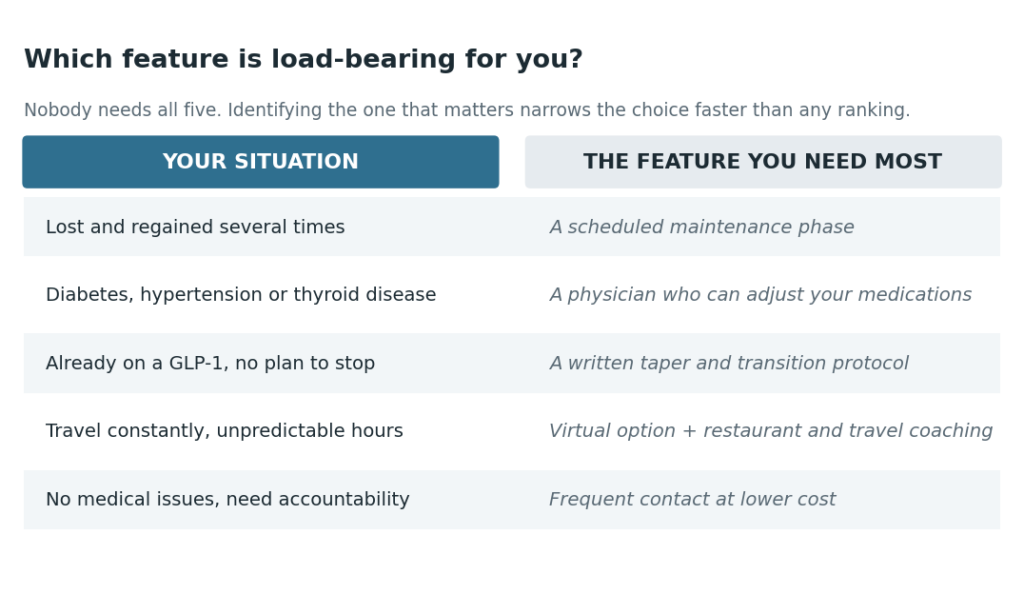
Nobody needs all five features equally. Working out which one is load-bearing for you narrows the field faster than any comparison.
If you have lost and regained several times, the maintenance phase is your variable. You have already demonstrated that you can lose weight; what has failed is the part after. Prioritize a program with a named maintenance phase of stated length and body composition tracking, and treat a program that ends at goal weight as disqualified regardless of how good the first six months look.
If you have diabetes, hypertension, thyroid disease or take medications that promote weight gain, physician involvement is not optional. Blood pressure and diabetes medications frequently need adjusting downward during weight loss, several common drug classes drive weight gain and can sometimes be swapped, and thyroid or insulin problems will not resolve through a diet plan. This is the profile where category matters most.
If you are already on a GLP-1 with no plan for stopping, the taper protocol is your variable. The STEP 1 extension describes exactly what happens without one. Look for a program that will re-measure your metabolic rate at your current weight, raise calories deliberately, taper rather than stop, and keep seeing you afterward.
If you travel constantly or work unpredictable hours, the practical structure decides everything. A program requiring weekly in-person visits will beat one that does not — right up until you miss six weeks. Look for a virtual or hybrid option, remote weight monitoring, and coaching that explicitly covers restaurants and travel.
If you have no medical complications and mainly need accountability, you may not need a medical program at all. A commercial or app-based program with genuine contact frequency may serve you well at a fraction of the cost. The honest advice here is to start there and escalate if it does not work.
Where Medication Fits
GLP-1 receptor agonists produce larger short-term weight loss than diet alone, and that is not in dispute. The question that decides long-term outcomes is what the program does around them.
Two problems need managing. The first is the discontinuation cliff already described. The second is quieter: these medications work by suppressing appetite, which makes it materially harder to eat enough protein at exactly the point in the process when protein matters most for protecting muscle. A program that prescribes a GLP-1, sets a protein target, monitors lean mass and adds strength work is addressing both problems. A program that prescribes and ships is addressing neither.
Whether medication is appropriate at all is a clinical decision that depends on your medical history, body composition and goals, and it should be made with a physician who has examined you.
How LeanMD Is Built Against the Five
LeanMD runs in three phases. Phase 1, active weight loss, lasts 2 to 12 months, with body composition analysis, vital signs and nutrition counseling at visits and optional medication when clinically appropriate. Phase 2, three to five weeks, is the structured transition: basal metabolic rate re-analyzed at the new body composition, calories raised deliberately, macronutrients adjusted, activity increased, medication tapered rather than stopped. Phase 3 runs 12 months of maintenance.
Food is groceries you buy and cook — no meals, shakes or bars are sold — with counseling on portions, shopping, cooking, restaurants and travel, and vegetarian and vegan plans supported. Muscle is treated as the asset to defend through protein guidance, muscle mass monitoring and strength-focused recommendations. Visit cadence is stated up front, with weekly in-office visits available or a flexible hybrid using a wireless e-scale.
What it is not: it is not billed to insurance, and it requires showing up. If either of those is a dealbreaker for your circumstances, a different category is a better fit, and the consultation is a reasonable place to work that out honestly.
Frequently Asked Questions
What is the best program for weight loss?
There is no single best weight loss program, because the published evidence needed to establish one does not exist. A systematic review in Annals of Internal Medicine found long-term randomized evidence for only two major commercial programs. What the evidence does support are five features: adequate contact frequency, body composition measurement rather than scale weight alone, a food approach you can sustain without buying products, protein and resistance training to protect lean mass, and a defined maintenance phase after goal weight.
What is the most effective type of weight loss program?
Effectiveness depends on what is driving your weight. If a medical condition or a current medication contributes, a physician-led program is the only category that can address it. If you mainly need structure and accountability with no medical complications, a commercial or app-based program can work. Independent of category, the US Preventive Services Task Force found high-intensity programs delivering 12 to 26 sessions in the first year produced about 6 percent weight loss compared with 2.8 percent for fewer than 12 sessions.
Is medication or diet more effective for weight loss?
GLP-1 medications produce substantially greater short-term weight loss than diet alone, and that loss reverses substantially when they are stopped without a transition plan. In the STEP 1 trial extension, participants regained about two-thirds of their weight loss in the year after semaglutide was withdrawn. The practical answer is that they address different parts of the problem: medication changes appetite while it is taken, and the eating structure determines what happens after. Programs that use both, with a taper plan, are addressing the whole timeline.
How long should you stay in a weight loss program?
Longer than the time it takes to lose the weight. The year immediately following weight loss carries the highest risk of regain, which is why programs with a defined maintenance phase are structured differently from those that end at goal weight. The LeanMD program runs 2 to 12 months of active loss, 3 to 5 weeks of transition and 12 months of maintenance, so most patients are enrolled well over a year.
How do you choose a weight loss program?
Identify which single feature is load-bearing for your situation, then find a program that has it. Someone who has lost and regained repeatedly needs a maintenance phase. Someone with diabetes or hypertension needs a physician who can adjust medications during weight loss. Someone already on a GLP-1 needs a taper protocol. Someone who travels constantly needs a virtual option and restaurant coaching. Choosing by feature is far more reliable than choosing by brand or rating.
Work Out Which Feature Matters for You
That is what a consultation is for — with your body composition, metabolic rate and medical history actually measured rather than guessed at. Call Temkin Health at (925) 866-3900 or request a consultation online [https://drtemkin.com/contact-us/].
About Temkin Health
Temkin Health is a concierge internal medicine practice at 1081 Market Place, Suite 300, San Ramon, CA 94583, led by Dr. Michael Temkin, DO, a board-certified internal medicine physician with more than 25 years in private practice in San Ramon. The practice offers concierge primary care, the LeanMD medical weight loss program, bioidentical hormone replacement therapy for men and women, and longevity medicine. Phone: (925) 866-3900.
Related Reading
- What Weight Loss Programs Have Good Long Term Results? [https://drtemkin.com/blog/medical-weight-loss/what-weight-loss-programs-have-good-long-term-results/]
- What Are the Best Weight Loss Programs Near Me? A San Ramon and Tri-Valley Comparison [https://drtemkin.com/blog/medical-weight-loss/best-weight-loss-programs-near-me-san-ramon-tri-valley/]
- Which Weight Loss Programs Use Real Food Instead of Shakes or Prepackaged Meals? [https://drtemkin.com/blog/medical-weight-loss/weight-loss-program-that-uses-real-food/]
- How Do You Find a Sustainable Weight Loss Clinic Near You? [https://drtemkin.com/blog/medical-weight-loss/sustainable-weight-loss-clinic-near-me/]
- How Do You Tell If a Weight Loss Program Is Actually Science-Backed? [https://drtemkin.com/blog/medical-weight-loss/science-backed-weight-loss-program-near-me/]
- What Is LeanMD? Who Runs It and How the Program Works [https://drtemkin.com/blog/medical-weight-loss/what-is-leanmd-and-how-the-program-works/]
Each of the above is part of Temkin Health’s San Ramon medical weight loss resource library.
Sources
- Gudzune KA, et al. Efficacy of commercial weight-loss programs: an updated systematic review. Annals of Internal Medicine. 2015;162(7). PubMed 25844997 [https://pubmed.ncbi.nlm.nih.gov/25844997/].
- Thomas JG, et al. Weight-loss maintenance for 10 years in the National Weight Control Registry. American Journal of Preventive Medicine. 2014. PubMed 24355667 [https://pubmed.ncbi.nlm.nih.gov/24355667/].
- Wilding JPH, et al. Weight regain and cardiometabolic effects after withdrawal of semaglutide: the STEP 1 trial extension. Diabetes, Obesity and Metabolism. 2022. PubMed 35441470 [https://pubmed.ncbi.nlm.nih.gov/35441470/].
- Neeland IJ, et al. Changes in lean body mass with glucagon-like peptide-1-based therapies and mitigation strategies. Diabetes, Obesity and Metabolism. 2024. doi:10.1111/dom.15728 [https://dom-pubs.onlinelibrary.wiley.com/doi/10.1111/dom.15728].
- Longland TM, et al. Higher compared with lower dietary protein during an energy deficit combined with intense exercise promotes greater lean mass gain and fat mass loss. American Journal of Clinical Nutrition. Full text [https://ajcn.nutrition.org/article/S0002-9165(22)06559-5/fulltext].
- US Preventive Services Task Force. Weight Loss to Prevent Obesity-Related Morbidity and Mortality in Adults: Behavioral Interventions. [https://www.uspreventiveservicestaskforce.org/uspstf/recommendation/obesity-in-adults-interventions]
Compounded drug products are not FDA-approved, which means the FDA does not evaluate compounded products for safety, effectiveness or quality. A LeanMD clinician may prescribe compounded or FDA-approved generic medications when medically necessary, based on a patient’s specific needs. Results may vary by patient; there are no guarantees, and outcomes depend on individual body composition, medical history and adherence. This article provides general health information and is not medical advice for any specific situation. Reading it does not create a doctor-patient relationship. Consult a licensed healthcare provider to discuss all treatment options, including potential risks and benefits.
Last updated August 2026.