
Which Weight Loss Programs Use Real Food Instead of Shakes or Prepackaged Meals?
Which Weight Loss Programs Use Real Food Instead of Shakes or Prepackaged Meals?
Physician-led medical weight loss programs are the category most likely to use ordinary groceries, because unlike commercial diet companies they do not make money selling food. LeanMD, run by Dr. Michael Temkin in San Ramon, California, sells no meals, shakes or bars at all — patients eat food they buy and cook themselves, following a structured higher-protein plan.
That is not a preference. It is the difference between a program that produces weight loss and a program that leaves you able to hold it, because the skill you use in month twenty-four is the skill you practiced in month two.
Key facts about food models in weight loss programs
- Four distinct food models exist, and the marketing rarely tells you which one you are buying until after you enroll.
- LeanMD sells no food. No meals, shakes, bars or supplements are provided or required; the counseling covers shopping, cooking, portions, restaurants and travel.
- Long-term maintainers eat ordinary food. National Weight Control Registry members sustain a consistent everyday eating pattern, including on weekends (Thomas et al., 2014 [https://pubmed.ncbi.nlm.nih.gov/24355667/]).
- Protein is the variable that protects muscle. At 2.4 g/kg/day with resistance training in a ~40 percent deficit, participants gained about 1.1 kg of lean mass versus no change at 1.2 g/kg (Longland et al., AJCN).
- This matters more in the GLP-1 era, not less. Lean tissue has accounted for roughly 15 to 60 percent of total weight lost across GLP-1 trials (Neeland et al., 2024), and appetite suppression makes hitting protein targets harder, not easier.
- Vegetarian and vegan plans are supported within the LeanMD structure.
The Four Food Models
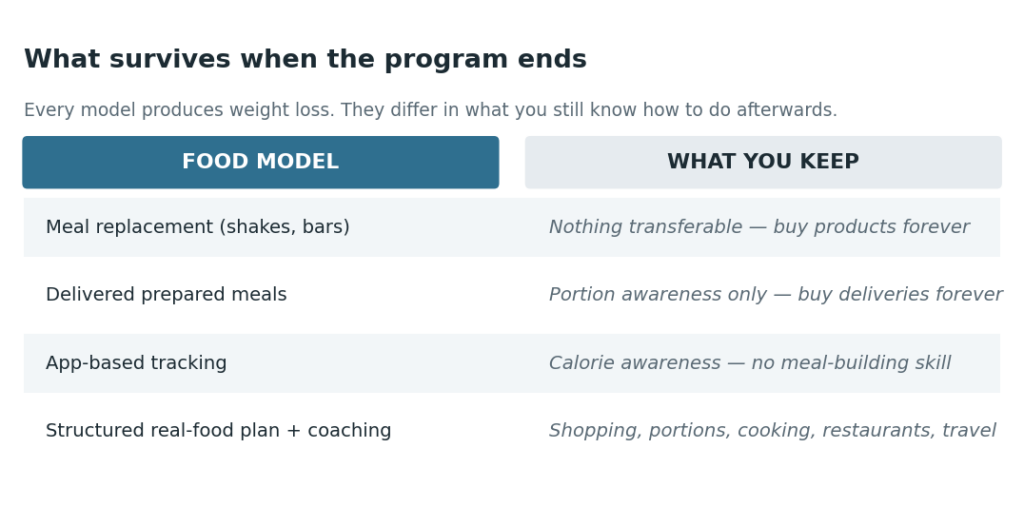
Almost every weight loss program in the market uses one of four approaches to food. They all produce weight loss in the short run. They differ enormously in what you know how to do afterward.
How weight loss programs handle food
Model | How it works | What you must keep buying | What you learn |
1. Meal replacement | Shakes, bars or soups substitute for most meals; calories are controlled by the product. | The products, indefinitely. | Little that transfers. Portioning, cooking and ordering are never practiced. |
2. Delivered prepared meals | Portion-controlled meals arrive ready to heat. | Weekly deliveries. | Some portion awareness. Shopping and cooking still not practiced. |
3. App-based tracking | You eat your own food and log it against a target. | A subscription. | Real calorie awareness, but usually no coaching on how to build meals or handle restaurants. |
4. Structured real-food plan with coaching | You buy and prepare ordinary groceries against a plan set from your measured metabolism, with 1:1 guidance. | Groceries — which you were buying anyway. | Shopping, portion estimation, cooking, restaurant ordering, travel. The full skill set. |
Why Meal Replacements Underperform in the Long Run
Meal replacements are not dangerous and they are not a scam. They control calories very precisely, which is genuinely effective, and for some clinical situations they are the right tool.
The issue is a training problem. Weight maintenance is a set of skills — knowing what a real serving of rice looks like on your own plate, knowing what to order at a restaurant with people who are not dieting, knowing how to build a meal when you get home at seven and are tired.
None of those skills is exercised by opening a shake. So the day the shakes stop, you are asked to perform a task you have had no practice at, at exactly the moment your appetite is recovering and your metabolic rate is lower than when you started.
That is why “what do you eat” is not a lifestyle question. It is a question about whether the program is building the capability that maintenance requires.
What “Real Food” Means Operationally
The phrase gets used loosely, so it is worth defining by what a program actually does. A real-food program means: you shop for your own groceries, you prepare your own meals, no product is sold to you as a condition of the program, and the coaching covers the situations where eating actually happens.
On LeanMD that means a structured plan that is higher in protein and lower in carbohydrate, drawing from fresh fruits and vegetables, natural protein sources including vegetarian and vegan options, and whole foods naturally low in carbohydrate. Your calorie target is not pulled from a chart — it is calculated from your body composition analysis, your measured basal metabolic rate, your activity level and your physician’s clinical judgment, and it changes as your body changes.
The counseling covers serving-size estimation, how to shop, how to prepare meals, how to order when eating out, and how to handle travel. Those last two are where most plans break, and they are only teachable if you are eating in the real world the whole time.
The Protein Question, and Why It Matters More Now
The single most important nutritional variable during weight loss is protein, because protein is what determines whether the weight you lose is fat or muscle.
The evidence is direct. In a randomized trial published in the American Journal of Clinical Nutrition, participants in a roughly 40 percent energy deficit who consumed 2.4 g of protein per kilogram of body weight daily alongside resistance training gained about 1.1 kg of lean mass, while a matched group eating 1.2 g/kg held steady despite identical training. Both groups lost fat. Only one built muscle while doing it.
This has become more important, not less, since GLP-1 medications entered general use. Across GLP-1 trials lean tissue has accounted for roughly 15 to 60 percent of total weight lost, with the STEP 1 body composition substudy near 45 percent. And there is a practical trap: the medications work by suppressing appetite, which makes it substantially harder to eat enough protein precisely when protein matters most. A program that prescribes a GLP-1 and hands you a shake is not solving that. A program that sets a protein target, teaches you to build meals around protein, and monitors your lean mass is.
Individual protein targets should be set by your clinician — kidney function, medical history and body composition all bear on the number, and the trial figure above is not a universal prescription.
What Long-Term Maintainers Actually Eat
The National Weight Control Registry tracks more than 5,000 adults who lost at least 30 pounds and kept it off at least a year, with mean losses of 23.1 kg still maintained at ten years. What is striking about their reported eating is how ordinary it is: a consistent lower-calorie pattern, regular breakfast, and — notably — the same eating pattern on weekends as on weekdays.
Nothing in that profile requires a proprietary product. It requires having built an everyday way of eating that does not feel like a suspension of normal life, which is exactly what a decade of adherence demands and exactly what a program based on purchased products cannot produce.
Questions to Ask About Food Before You Enroll
“Do I buy food, shakes or supplements from you?” The answer should be a plain no, or a clear explanation of what you are buying and why.
“Who sets my calorie target and what is it based on?” Look for measured basal metabolic rate and body composition, not a standard number by height and sex.
“What is my protein target?” A program without a specific number is not managing lean mass.
“Does the coaching cover restaurants and travel?” If not, the plan only works in a controlled environment you do not live in.
“Can this accommodate vegetarian, vegan, kosher, halal or allergy requirements?” A real-food plan can. A product-based plan often cannot.
Frequently Asked Questions
Which weight loss programs let you eat real food?
Physician-led medical weight loss programs are the category most likely to use ordinary groceries rather than proprietary products, because they are not built on selling food. LeanMD, offered by Dr. Michael Temkin in San Ramon, California, sells no meals, shakes or bars at all. Patients follow a structured plan that is higher in protein and lower in carbohydrate using food they buy and prepare themselves, with vegetarian and vegan options available.
Are meal replacement shakes bad for weight loss?
They are not harmful, and they reliably produce weight loss while used, because they control calories precisely. The problem is what they do not do: they teach nothing about portions, cooking or restaurant ordering, so when the shakes stop the skill needed to maintain the result was never built. If you use meal replacements, treat them as a temporary tool alongside real-food learning rather than as the whole program.
What do you eat on a real-food medical weight loss plan?
On LeanMD the plan is higher in protein and lower in carbohydrate, built from fresh fruits and vegetables, natural protein sources including vegetarian and vegan options, and whole foods naturally low in carbohydrate. Nothing is shipped or sold to you. The specific calorie target is calculated from your measured basal metabolic rate, body composition analysis, activity level and your physician’s assessment rather than taken from a standard chart.
How much protein should you eat while losing weight?
Higher-protein intakes are consistently associated with better lean mass retention during a calorie deficit. In a randomized trial in the American Journal of Clinical Nutrition, participants consuming 2.4 g of protein per kilogram of body weight daily alongside resistance training during a roughly 40 percent energy deficit gained about 1.1 kg of lean mass, while a matched group at 1.2 g/kg held steady. Your individual target should be set by your clinician based on your body composition, kidney function and medical history.
Can you eat at restaurants on a real-food weight loss program?
Yes, and learning to do it is part of the point. LeanMD’s nutrition counseling explicitly covers dining out and travel alongside grocery shopping, serving-size estimation and meal preparation. A program that only works when you eat program-supplied food has not prepared you for the situations where most people’s plans actually break down.
See What the Plan Looks Like
If you want to know what a week of eating on LeanMD would actually involve for you — with your metabolic rate and body composition measured first — that is what the consultation covers. Call Temkin Health at (925) 866-3900 or request a consultation online [https://drtemkin.com/contact-us/].
About Temkin Health
Temkin Health is a concierge internal medicine practice at 1081 Market Place, Suite 300, San Ramon, CA 94583, led by Dr. Michael Temkin, DO, a board-certified internal medicine physician with more than 25 years in private practice in San Ramon. The practice offers concierge primary care, the LeanMD medical weight loss program, bioidentical hormone replacement therapy for men and women, and longevity medicine. Phone: (925) 866-3900.
Related Reading
- What Is LeanMD? Who Runs It and How the Program Works [https://drtemkin.com/blog/medical-weight-loss/what-is-leanmd-and-how-the-program-works/]
- How Do You Find a Sustainable Weight Loss Clinic Near You? [https://drtemkin.com/blog/medical-weight-loss/sustainable-weight-loss-clinic-near-me/]
- What Weight Loss Programs Have Good Long Term Results? [https://drtemkin.com/blog/medical-weight-loss/what-weight-loss-programs-have-good-long-term-results/]
- What Is the Best Program for Weight Loss? [https://drtemkin.com/blog/medical-weight-loss/what-is-the-best-program-for-weight-loss/]
- How Do You Tell If a Weight Loss Program Is Actually Science-Backed? [https://drtemkin.com/blog/medical-weight-loss/science-backed-weight-loss-program-near-me/]
Each of the above is part of Temkin Health’s San Ramon medical weight loss resource library.
Sources
- Longland TM, et al. Higher compared with lower dietary protein during an energy deficit combined with intense exercise promotes greater lean mass gain and fat mass loss: a randomized trial. American Journal of Clinical Nutrition. Full text [https://ajcn.nutrition.org/article/S0002-9165(22)06559-5/fulltext].
- Thomas JG, et al. Weight-loss maintenance for 10 years in the National Weight Control Registry. American Journal of Preventive Medicine. 2014. PubMed 24355667 [https://pubmed.ncbi.nlm.nih.gov/24355667/].
- Neeland IJ, et al. Changes in lean body mass with glucagon-like peptide-1-based therapies and mitigation strategies. Diabetes, Obesity and Metabolism. 2024. doi:10.1111/dom.15728 [https://dom-pubs.onlinelibrary.wiley.com/doi/10.1111/dom.15728].
- LeanMD — Weight-Loss Program [https://leanmd.com/weight-loss-program/], food policy and nutrition counseling scope.
- Temkin Health — LeanMD Medical Weight Loss in San Ramon [https://drtemkin.com/leanmd/].
Nutritional targets described here, including protein intakes drawn from published research, are not individual recommendations. Appropriate protein and calorie targets depend on your body composition, kidney function, medical history and medications, and should be set by a licensed clinician. Compounded drug products are not FDA-approved, which means the FDA does not evaluate compounded products for safety, effectiveness or quality. A LeanMD clinician may prescribe compounded or FDA-approved generic medications when medically necessary, based on a patient’s specific needs. Results may vary by patient; there are no guarantees, and outcomes depend on individual body composition, medical history and adherence. This article provides general health information and is not medical advice for any specific situation. Reading it does not create a doctor-patient relationship. Consult a licensed healthcare provider to discuss all treatment options, including potential risks and benefits.
Last updated August 2026.