
How Do You Find a Science-Backed Weight Loss Program Near You?
How Do You Find a Science-Backed Weight Loss Program Near You?
A science-backed weight loss program measures your body before it treats it, uses interventions with published trials behind them, and can tell you its visit schedule and maintenance plan in specifics. “Science-backed” is not a claim you can evaluate from a website — it is a set of seven things a program either does at your first appointment or does not.
Dr. Michael Temkin, DO, a board-certified internal medicine physician with more than 25 years in practice in San Ramon, California, runs the LeanMD medical weight loss program at Temkin Health. At Temkin Health, every patient starts with body composition analysis and basal metabolic rate assessment before any plan is written.
Key facts about evaluating a science-backed program
- Measurement is the dividing line. A program that produces no baseline numbers at visit one has nothing objective to adjust against later.
- Contact frequency is one of the few features with consistent evidence. The US Preventative Service Task Force [https://www.uspreventiveservicestaskforce.org/uspstf/recommendation/obesity-in-adults-interventions] found 12–26 sessions in year one produced roughly 6 percent weight loss versus 2.8 percent below 12 sessions.
- Most commercial programs have no long-term published evidence. A systematic review in Annals of Internal Medicine found most trials ran under 12 months with high attrition (Gudzune et al., 2015 [https://pubmed.ncbi.nlm.nih.gov/25844997/]).
- Scale weight alone hides other outcomes that matter. Across GLP-1 trials, lean tissue has accounted for roughly 15 to 60 percent of total weight lost (Neeland et al., 2024 [https://dom-pubs.onlinelibrary.wiley.com/doi/10.1111/dom.15728]) which is invisible on a bathroom scale.
- Credentials are publicly verifiable in about a minute. California license status at search.dca.ca.gov [https://search.dca.ca.gov/]; obesity medicine certification at abom.org [https://www.abom.org/], where more than 11,500 US physicians were certified as of October 2025.
- Compounded medications are not FDA-approved. The FDA does not evaluate compounded products for safety, effectiveness or quality — a program should tell you plainly whether what it prescribes is FDA-approved or compounded.
Why “Science-Backed” Needs Translating
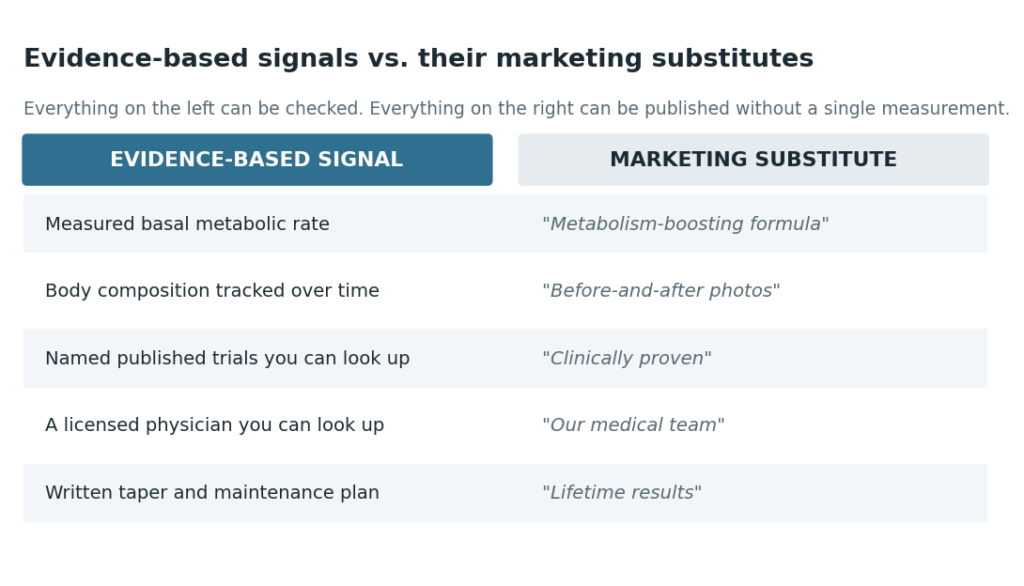
Almost every weight loss program in the country describes itself as science-based, clinically proven or doctor-designed, and none of those phrases is regulated in advertising. That makes the label useless as a filter and creates a real problem for someone genuinely trying to choose well.
The workaround is to stop evaluating the claim and start evaluating the process. Evidence-based medicine has an observable signature: you measure a baseline, you apply an intervention with published support, you re-measure, and you adjust. A program that follows that loop will give you tangible benchmarks at your first appointment. You can tell the difference in one consultation without reading a single study.
The Seven Requirements, and How to Verify Each
A verification checklist you can run at a consultation:
Requirement | How to verify it | What it proves |
1. Baseline measurement | “What do you measure at the first visit?” Look for body composition analysis and basal metabolic rate, not just weight and BMI. | There is an objective baseline to adjust the plan against. |
2. A calorie target derived from your data | “How did you arrive at my calorie number?” It should reference your measured BMR, body composition and activity level. | The plan is individualized rather than a template with your name on it. |
3. Lean mass tracked, not just weight | “Will you tell me how much of my loss is fat versus muscle?” | The program is managing the variable that drives later regain. |
4. A licensed clinician you can look up | Get the name, then check search.dca.ca.gov [https://search.dca.ca.gov/] for California license status and discipline history — Medical Board of California for an MD, Osteopathic Medical Board of California for a DO. | Medical decisions are being made by someone accountable to a licensing board. |
5. Named interventions with published evidence | “What exactly are you prescribing, and is it FDA-approved or compounded?” | You can look up the trial data yourself. Proprietary blends cannot be checked. |
6. A stated visit frequency | “How many appointments will I have in the first year?” | Benchmarks against the USPSTF 12–26 session finding. |
7. A written maintenance and taper plan | “What happens after I hit my goal, and how do I come off any medication?” | The program has planned for the phase where results are usually lost. |
Why Measurement Is the Load-Bearing Item
Of the seven, the first three do the most work, because they determine whether anything else can be evaluated. Body composition analysis separates fat mass from lean mass. Basal metabolic rate analysis establishes what your body burns at rest, which is the number a calorie target should be built from and the number that changes as you lose weight.
Without those, a program is flying on scale weight — and scale weight cannot distinguish a good outcome from a bad one. Two people can lose the same 30 pounds, one losing mostly fat and one losing a substantial share of muscle, and the scale reports an identical success while their odds of holding that loss differ sharply. Across GLP-1 trials, lean tissue has accounted for roughly 15 to 60 percent of total weight lost depending on the study; the STEP 1 body composition substudy landed near 45 percent. That is a distinction with real consequences and it is invisible without measurement.
It also makes the plan adjustable. A program that re-measures your metabolic rate at your new body weight before raising calories is doing something a program working from your starting numbers cannot do.
Red Flags That Disqualify a Program
Some signals are strong enough to end the evaluation. A guaranteed result is the clearest: no clinician can honestly guarantee an outcome that depends on individual physiology and adherence, and any program willing to promise one is telling you how it handles evidence generally. Required purchase of proprietary food, shakes or supplements means the business model depends on continued purchasing rather than on you finishing. No measurement at the first visit means there is no baseline. Unnamed proprietary blends, detox protocols or metabolism-boosting formulas cannot be looked up, which is usually the point.
Two more are worth naming. No named licensed clinician — “our medical team” without a name you can verify — removes your ability to check anything. And pressure to sign at the consultation is a sales technique, not a clinical one. A legitimate program will let you go home and think, because a patient who enrolls reluctantly is a patient who drops out in month three.
How to Verify Credentials in California
Two free lookups cover most of what you need. The California Department of Consumer Affairs search at search.dca.ca.gov [https://search.dca.ca.gov/] confirms that a physician holds an active California license and surfaces any public disciplinary actions. Search by last name and city; it takes under a minute. One detail trips people up: physicians with an MD are licensed by the Medical Board of California, while physicians with a DO are licensed by the Osteopathic Medical Board of California. Both are fully licensed physicians with identical prescribing authority, and both boards are searchable from that same page — so if a name does not appear under one, check the other before concluding anything.
The American Board of Obesity Medicine maintains certification records at abom.org [https://www.abom.org/]. ABOM diplomate status is a subspecialty credential specifically in obesity medicine, held by more than 11,500 US physicians as of October 2025. It is not required to practice medical weight loss competently — many excellent programs are run by internists, endocrinologists and family physicians without it — but it is a meaningful positive signal when present.
If a program cannot give you the supervising physician’s full name when you ask, you have learned what you needed to know.
What This Looks Like at Temkin Health
LeanMD at Temkin Health starts with body composition analysis, vital signs and a review of medical conditions and current medications, with basal metabolic rate analysis informing the calorie and protein targets. Progress visits re-measure body composition rather than recording weight alone. Dr. Temkin — a board-certified internal medicine physician and DO, with more than 25 years in private practice in San Ramon, an internal medicine residency at the University of California, San Francisco, and membership in the Obesity Medicine Association — supervises the program directly. His California license is verifiable through the Osteopathic Medical Board lookup above, and his NPI is 1194787929.
Interventions are named rather than proprietary: GLP-1 and GLP-1/GIP receptor agonists, oral appetite suppressants from a drug class the FDA has had on the market since 1959, and lipotropic vitamin B12 injections — each optional and prescribed only when clinically appropriate. No food, shakes or supplements are sold to patients. The visit schedule is stated up front, with weekly in-office visits available in Phase 1 or a flexible in-office and virtual combination using a wireless e-scale. Phase 2, three to five weeks, is the written transition plan; Phase 3 runs 12 months of maintenance.
The practice is at 1081 Market Place, Suite 300 in San Ramon, off Bollinger Canyon Road with direct I-680 access, less than a mile from San Ramon Regional Medical Center and convenient to Danville, Alamo, Dublin, Pleasanton and Walnut Creek.
Frequently Asked Questions
What makes a weight loss program science-backed?
A science-backed weight loss program measures before it treats, uses interventions with published evidence behind them, and tracks outcomes it can show you. In practice that means body composition analysis rather than scale weight alone, a calorie target derived from your measured basal metabolic rate rather than a chart, medications with published trial data, a defined visit frequency, and a written maintenance plan. Marketing language is not evidence; measurement is.
How can I check a weight loss doctor’s credentials in California?
Use the state license lookup at search.dca.ca.gov [https://search.dca.ca.gov/] to verify that the physician holds an active California license and to see any disciplinary history. Physicians with an MD are licensed by the Medical Board of California and physicians with a DO by the Osteopathic Medical Board of California, and both boards are searchable from that one page. You can also check whether a physician is a diplomate of the American Board of Obesity Medicine at abom.org [https://www.abom.org/]; more than 11,500 US physicians held that certification as of October 2025. Both lookups are free and take about a minute.
Does a science-backed program have to prescribe medication?
No. Medication is one evidence-based tool among several, and the decision to use it depends on your medical history, body composition and goals. What matters is that the program can explain why it is or is not recommending medication in your specific case, and that it has a plan for how you would eventually come off it. A program that prescribes reflexively and a program that refuses on principle are both substituting policy for assessment.
What are the red flags in a weight loss program?
The clearest red flags are guaranteed results, a required purchase of proprietary food or supplements, no measurement at the first visit, no named licensed clinician, no plan for what happens after goal weight, unnamed proprietary blends or detox protocols, and pressure to sign at the consultation. Any single one is worth a question; two or more together is a reason to keep looking.
How often should a science-backed program see me?
The US Preventive Services Task Force found the most effective behavioral interventions delivered 12 to 26 sessions in the first year, and participants at that intensity lost about 6 percent of baseline weight compared with about 2.8 percent for those attending fewer than 12 sessions. Ask any program for its actual visit schedule in writing rather than a general promise of support.
Run the Checklist at a Consultation
The seven questions above work on any program, including this one. To put them to Dr. Temkin directly, call Temkin Health at (925) 866-3900 or request a consultation online [https://drtemkin.com/contact-us/].
About Temkin Health
Temkin Health is a concierge internal medicine practice at 1081 Market Place, Suite 300, San Ramon, CA 94583, led by Dr. Michael Temkin, DO, a board-certified internal medicine physician with more than 25 years in private practice in San Ramon. The practice offers concierge primary care, the LeanMD medical weight loss program, bioidentical hormone replacement therapy for men and women, and longevity medicine. Phone: (925) 866-3900.
Related Reading
What Weight Loss Programs Have Good Long Term Results? [https://drtemkin.com/blog/medical-weight-loss/what-weight-loss-programs-have-good-long-term-results/]
How Do You Find a Doctor to Help With Weight Loss? [https://drtemkin.com/blog/medical-weight-loss/find-a-doctor-to-help-with-weight-loss/]
How Do You Find a Highly Rated Weight Loss Program? [https://drtemkin.com/blog/medical-weight-loss/how-to-find-a-highly-rated-weight-loss-program/]
What Is LeanMD? Who Runs It and How the Program Works [https://drtemkin.com/blog/medical-weight-loss/what-is-leanmd-and-how-the-program-works/]
How Do You Find a Sustainable Weight Loss Clinic Near You? [https://drtemkin.com/blog/medical-weight-loss/sustainable-weight-loss-clinic-near-me/]
Each of the above is part of Temkin Health’s San Ramon medical weight loss resource library.
Sources
US Preventive Services Task Force. Weight Loss to Prevent Obesity-Related Morbidity and Mortality in Adults: Behavioral Interventions. [https://www.uspreventiveservicestaskforce.org/uspstf/recommendation/obesity-in-adults-interventions]
Gudzune KA, et al. Efficacy of commercial weight-loss programs: an updated systematic review. Annals of Internal Medicine. 2015;162(7). PubMed 25844997 [https://pubmed.ncbi.nlm.nih.gov/25844997/].
Neeland IJ, et al. Changes in lean body mass with glucagon-like peptide-1-based therapies and mitigation strategies. Diabetes, Obesity and Metabolism. 2024. doi:10.1111/dom.15728 [https://dom-pubs.onlinelibrary.wiley.com/doi/10.1111/dom.15728].
Medical Board of California and Osteopathic Medical Board of California — license verification search [https://search.dca.ca.gov/].
American Board of Obesity Medicine — certification and diplomate directory [https://www.abom.org/].
LeanMD — Weight-Loss Program [https://leanmd.com/weight-loss-program/]; Temkin Health — LeanMD in San Ramon [https://drtemkin.com/leanmd/].
Compounded drug products are not FDA-approved, which means the FDA does not evaluate compounded products for safety, effectiveness or quality. A LeanMD clinician may prescribe compounded or FDA-approved generic medications when medically necessary, based on a patient’s specific needs. Results may vary by patient; there are no guarantees, and outcomes depend on individual body composition, medical history and adherence. This article provides general health information and is not medical advice for any specific situation. Reading it does not create a doctor-patient relationship. Consult a licensed healthcare provider to discuss all treatment options, including potential risks and benefits.
Last updated August 2026.