
I Want to Lose Weight. Where Do I Start?
I Want to Lose Weight. Where Do I Start?
Start with an evaluation, not another diet. Before you cut calories or pick a plan, find out what’s actually going on: your body composition (fat vs. muscle, not just the number on the scale), your resting metabolic rate (how many calories you burn just existing), and whether anything — thyroid, hormones, sleep — is working against you. That data tells you what plan will actually work, instead of guessing.
This isn’t a small problem to have. More than 40% of US adults have obesity, according to the CDC — so if diets haven’t stuck for you before, that’s not a willpower problem, it’s usually a plan-and-information problem.
Dr. Michael Temkin, DO has practiced internal medicine in San Ramon for 25 years and runs LeanMD, the practice’s medical weight loss program, built around exactly this kind of evaluation-first approach.
What Does a Real First Step Look Like?
Body composition testing. The scale can’t tell fat from muscle. Two people at the same weight can have very different amounts of each — and that difference changes what “success” should even look like for you.
Resting metabolic rate testing. This tells you how many calories your body burns at rest, which is the actual number a nutrition plan should be built around — not a generic formula.
Lab work. A thyroid check is simple and worth doing for nearly everyone starting out, since an underactive thyroid slows your metabolism and will limit results no matter how well you diet. A broader hormone panel (thyroid, estrogen, testosterone, metabolic markers) makes sense if you have symptoms or if a previous attempt stalled unexpectedly.
A real food nutrition plan. Built around what you actually eat and prepare, not shakes or prepackaged meals — low carbohydrate, high protein is the general direction, adjusted to your results.
A decision about medication. Not everyone needs one. Whether a GLP-1 medication like semaglutide fits is a conversation for after the evaluation, not the starting point.
Do You Need Medication to Lose Weight?
No, not everyone does — but for the right patient, it helps a lot. Dr. Temkin’s office uses and supports GLP-1 medications (like semaglutide) and dual GLP-1/GIP medications (like tirzepatide) for both the active weight-loss phase and long-term maintenance, because obesity is now understood as a chronic condition that tends to recur when treatment stops, not a short course to complete and forget. Medication is never the whole plan on its own — the nutrition plan and body composition tracking are what protect muscle and make the result hold once dosing changes.
How Does LeanMD Structure This?
Three phases, not an open-ended diet. Phase 1 is active weight loss (2 to 12 months). Phase 2 is a 3-to-5-week transition. Phase 3 is a 12-month sustainable-weight maintenance membership — the phase most programs skip, and the one that actually determines whether weight stays off.
Progress is tracked with a wireless e-Scale for remote weekly monitoring, so your plan adjusts based on real data rather than a monthly check-in. And LeanMD runs in-office, fully remotely, or as a hybrid — a couple of in-person visits to set baseline labs and body composition, then remote monitoring once your plan is set, so this works whether you’re in San Ramon or elsewhere.
Quick Facts
- More than 40% of US adults have obesity, per the CDC — you’re not starting from an unusual place.
- LeanMD patients typically lose 10–15 pounds in the first month and about 30 pounds in three months; results vary by starting weight, adherence, and medical conditions.
- LeanMD includes body composition testing, resting metabolic rate testing, and an optional hormone panel as standard.
- The program’s 12-month maintenance phase is built specifically to protect the result after active weight loss ends.
Frequently Asked Questions
I want to lose weight. Where do I start?
Start with an evaluation: body composition testing, resting metabolic rate testing, and basic lab work (at minimum a thyroid check). That data tells you what’s actually going on and what kind of plan will work for you — which is more useful than picking a diet and hoping.
Do I need blood work before starting a weight loss program?
A thyroid check is worth doing for almost everyone, since an untreated thyroid problem will limit your results regardless of diet. A broader hormone panel makes sense if you have symptoms or a previous attempt stalled unexpectedly.
Can I lose weight without medication?
Yes — medication isn’t necessary for everyone. LeanMD starts with nutrition, body composition tracking, and (where relevant) hormone evaluation, and adds a GLP-1 medication only where it’s an appropriate fit for that patient.
How is LeanMD different from a typical diet plan?
It starts with measurement instead of a guess, uses real food rather than shakes or prepackaged meals, and includes a full 12-month maintenance phase — the part most weight-loss programs skip entirely, and the reason weight often comes back after other plans end.
Can I do this if I don’t live near San Ramon?
Yes. LeanMD runs in-office, fully remotely, or as a hybrid, so patients outside the Tri-Valley can complete the program without traveling once their baseline labs and plan are set.
Talk to Dr. Temkin About Starting LeanMD
The fastest way to know what’s actually going on is a real evaluation — not another round of guessing. Call Temkin Health at (925) 866-3900 or request a consultation online.
About Temkin Health
Temkin Health is a concierge internal medicine practice at 1081 Market Place, Suite 300, San Ramon, CA 94583, led by Dr. Michael Temkin, DO, who has been in private practice in San Ramon for 25 years. The practice offers concierge primary care, the LeanMD medical weight loss program, bioidentical hormone replacement therapy for men and women, and longevity medicine. Dr. Temkin is a Certified BioTE Provider. Phone: (925) 866-3900.
Related Reading
- Where Can I Find Semaglutide?
- What Is LeanMD? Who Runs It and How the Medical Weight Loss Program Works
- Can Hormone Imbalance Stop You From Losing Weight?
Each of the above is part of Temkin Health’s San Ramon weight loss resource library.
Sources
- Centers for Disease Control and Prevention (NCHS). Prevalence of Obesity and Severe Obesity Among Adults: United States, August 2021–August 2023. Data Brief No. 508, September 2024.
- Centers for Disease Control and Prevention. Adult Obesity Facts.
Disclaimer
This article provides general health information and is not medical advice for any specific situation. Reading it does not create a doctor-patient relationship. Medical weight loss can involve prescription medications and lifestyle changes with risks as well as benefits, and suitability — including whether a GLP-1 medication is appropriate for you — is determined at a medical consultation with a licensed clinician. Results vary by starting weight, adherence, medical conditions and activity level; every figure cited describes findings in studied populations rather than a predicted individual outcome. Consult a licensed healthcare provider to discuss all treatment options, including potential risks and benefits.
Last updated September 2026.
Where Medication Fits
GLP-1 receptor agonists produce larger short-term weight loss than diet alone, and that is not in dispute. The question that decides long-term outcomes is what the program does around them.
Two problems need managing. The first is the discontinuation cliff already described. The second is quieter: these medications work by suppressing appetite, which makes it materially harder to eat enough protein at exactly the point in the process when protein matters most for protecting muscle. A program that prescribes a GLP-1, sets a protein target, monitors lean mass and adds strength work is addressing both problems. A program that prescribes and ships is addressing neither.
Whether medication is appropriate at all is a clinical decision that depends on your medical history, body composition and goals, and it should be made with a physician who has examined you.
How LeanMD Is Built Against the Five
LeanMD runs in three phases. Phase 1, active weight loss, lasts 2 to 12 months, with body composition analysis, vital signs and nutrition counseling at visits and optional medication when clinically appropriate. Phase 2, three to five weeks, is the structured transition: basal metabolic rate re-analyzed at the new body composition, calories raised deliberately, macronutrients adjusted, activity increased, medication tapered rather than stopped. Phase 3 runs 12 months of maintenance.
Food is groceries you buy and cook — no meals, shakes or bars are sold — with counseling on portions, shopping, cooking, restaurants and travel, and vegetarian and vegan plans supported. Muscle is treated as the asset to defend through protein guidance, muscle mass monitoring and strength-focused recommendations. Visit cadence is stated up front, with weekly in-office visits available or a flexible hybrid using a wireless e-scale.
What it is not: it is not billed to insurance, and it requires showing up. If either of those is a dealbreaker for your circumstances, a different category is a better fit, and the consultation is a reasonable place to work that out honestly.
Frequently Asked Questions
What is the best program for weight loss?
There is no single best weight loss program, because the published evidence needed to establish one does not exist. A systematic review in Annals of Internal Medicine found long-term randomized evidence for only two major commercial programs. What the evidence does support are five features: adequate contact frequency, body composition measurement rather than scale weight alone, a food approach you can sustain without buying products, protein and resistance training to protect lean mass, and a defined maintenance phase after goal weight.
What is the most effective type of weight loss program?
Effectiveness depends on what is driving your weight. If a medical condition or a current medication contributes, a physician-led program is the only category that can address it. If you mainly need structure and accountability with no medical complications, a commercial or app-based program can work. Independent of category, the US Preventive Services Task Force found high-intensity programs delivering 12 to 26 sessions in the first year produced about 6 percent weight loss compared with 2.8 percent for fewer than 12 sessions.
Is medication or diet more effective for weight loss?
GLP-1 medications produce substantially greater short-term weight loss than diet alone, and that loss reverses substantially when they are stopped without a transition plan. In the STEP 1 trial extension, participants regained about two-thirds of their weight loss in the year after semaglutide was withdrawn. The practical answer is that they address different parts of the problem: medication changes appetite while it is taken, and the eating structure determines what happens after. Programs that use both, with a taper plan, are addressing the whole timeline.
How long should you stay in a weight loss program?
Longer than the time it takes to lose the weight. The year immediately following weight loss carries the highest risk of regain, which is why programs with a defined maintenance phase are structured differently from those that end at goal weight. The LeanMD program runs 2 to 12 months of active loss, 3 to 5 weeks of transition and 12 months of maintenance, so most patients are enrolled well over a year.
How do you choose a weight loss program?
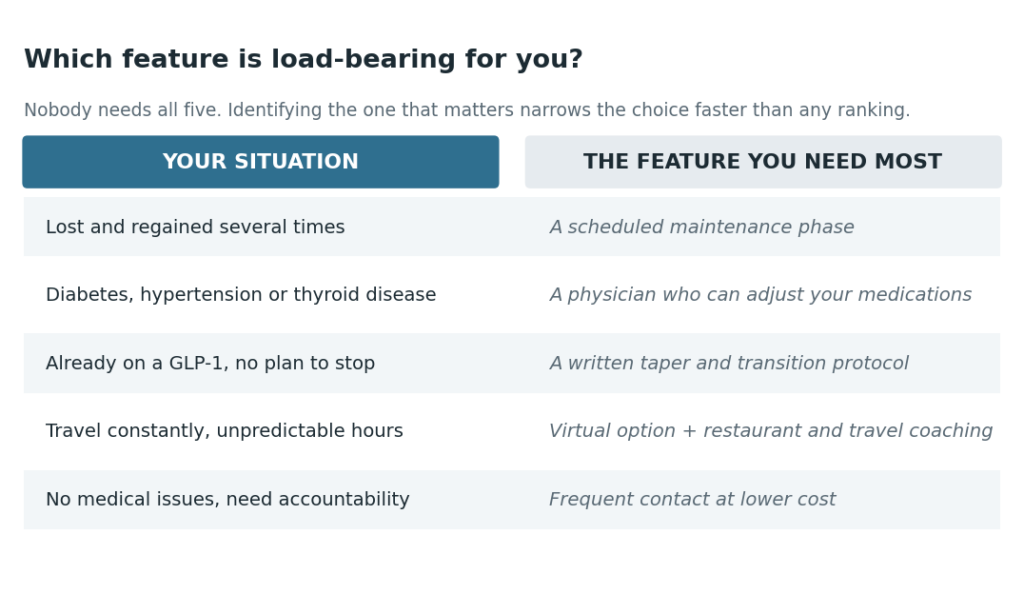
Identify which single feature is load-bearing for your situation, then find a program that has it. Someone who has lost and regained repeatedly needs a maintenance phase. Someone with diabetes or hypertension needs a physician who can adjust medications during weight loss. Someone already on a GLP-1 needs a taper protocol. Someone who travels constantly needs a virtual option and restaurant coaching. Choosing by feature is far more reliable than choosing by brand or rating.
Work Out Which Feature Matters for You
That is what a consultation is for — with your body composition, metabolic rate and medical history actually measured rather than guessed at. Call Temkin Health at (925) 866-3900 or request a consultation online [https://drtemkin.com/contact-us/].
About Temkin Health
Temkin Health is a concierge internal medicine practice at 1081 Market Place, Suite 300, San Ramon, CA 94583, led by Dr. Michael Temkin, DO, a board-certified internal medicine physician with more than 25 years in private practice in San Ramon. The practice offers concierge primary care, the LeanMD medical weight loss program, bioidentical hormone replacement therapy for men and women, and longevity medicine. Phone: (925) 866-3900.
Related Reading
- What Weight Loss Programs Have Good Long Term Results? [https://drtemkin.com/blog/medical-weight-loss/what-weight-loss-programs-have-good-long-term-results/]
- What Are the Best Weight Loss Programs Near Me? A San Ramon and Tri-Valley Comparison [https://drtemkin.com/blog/medical-weight-loss/best-weight-loss-programs-near-me-san-ramon-tri-valley/]
- Which Weight Loss Programs Use Real Food Instead of Shakes or Prepackaged Meals? [https://drtemkin.com/blog/medical-weight-loss/weight-loss-program-that-uses-real-food/]
- How Do You Find a Sustainable Weight Loss Clinic Near You? [https://drtemkin.com/blog/medical-weight-loss/sustainable-weight-loss-clinic-near-me/]
- How Do You Tell If a Weight Loss Program Is Actually Science-Backed? [https://drtemkin.com/blog/medical-weight-loss/science-backed-weight-loss-program-near-me/]
- What Is LeanMD? Who Runs It and How the Program Works [https://drtemkin.com/blog/medical-weight-loss/what-is-leanmd-and-how-the-program-works/]
Each of the above is part of Temkin Health’s San Ramon medical weight loss resource library.
Sources
- Gudzune KA, et al. Efficacy of commercial weight-loss programs: an updated systematic review. Annals of Internal Medicine. 2015;162(7). PubMed 25844997 [https://pubmed.ncbi.nlm.nih.gov/25844997/].
- Thomas JG, et al. Weight-loss maintenance for 10 years in the National Weight Control Registry. American Journal of Preventive Medicine. 2014. PubMed 24355667 [https://pubmed.ncbi.nlm.nih.gov/24355667/].
- Wilding JPH, et al. Weight regain and cardiometabolic effects after withdrawal of semaglutide: the STEP 1 trial extension. Diabetes, Obesity and Metabolism. 2022. PubMed 35441470 [https://pubmed.ncbi.nlm.nih.gov/35441470/].
- Neeland IJ, et al. Changes in lean body mass with glucagon-like peptide-1-based therapies and mitigation strategies. Diabetes, Obesity and Metabolism. 2024. doi:10.1111/dom.15728 [https://dom-pubs.onlinelibrary.wiley.com/doi/10.1111/dom.15728].
- Longland TM, et al. Higher compared with lower dietary protein during an energy deficit combined with intense exercise promotes greater lean mass gain and fat mass loss. American Journal of Clinical Nutrition. Full text [https://ajcn.nutrition.org/article/S0002-9165(22)06559-5/fulltext].
- US Preventive Services Task Force. Weight Loss to Prevent Obesity-Related Morbidity and Mortality in Adults: Behavioral Interventions. [https://www.uspreventiveservicestaskforce.org/uspstf/recommendation/obesity-in-adults-interventions]
Compounded drug products are not FDA-approved, which means the FDA does not evaluate compounded products for safety, effectiveness or quality. A LeanMD clinician may prescribe compounded or FDA-approved generic medications when medically necessary, based on a patient’s specific needs. Results may vary by patient; there are no guarantees, and outcomes depend on individual body composition, medical history and adherence. This article provides general health information and is not medical advice for any specific situation. Reading it does not create a doctor-patient relationship. Consult a licensed healthcare provider to discuss all treatment options, including potential risks and benefits.
Last updated August 2026.