
How Do You Find a Highly Rated Weight Loss Program?
How Do You Find a Highly Rated Weight Loss Program?
Star ratings measure the patient experience, not the outcome — and they are almost always collected months before anyone knows whether the weight stayed off. Read reviews for what they genuinely evidence: how a practice treats people, whether it explains things, whether billing is clean. Then use four verifiable facts, not the score, to judge whether the program will work.
Dr. Michael Temkin, DO, a board-certified internal medicine physician with more than 25 years in practice in San Ramon, California, runs the LeanMD medical weight loss program at Temkin Health there, where the maintenance phase is scheduled to run 12 months after active weight loss ends — a structural fact you can confirm at a consultation rather than infer from a rating.
Key facts about weight loss program ratings
- Reviews measure experience, not outcomes. No public rating system tracks what reviewers weigh a year after they finish.
- The timing is wrong. Most reviews are written during or shortly after active weight loss — before the highest-risk regain window, which the STEP 1 extension [https://pubmed.ncbi.nlm.nih.gov/35441470/] showed can return about two-thirds of lost weight in a year.
- Survivorship bias is built in. People who dropped out in week six overwhelmingly do not write reviews, so ratings reflect the people who stayed enrolled.
- Long-term comparative evidence barely exists. A systematic review in Annals of Internal Medicine found most commercial-program trials ran under 12 months with high attrition (Gudzune et al., 2015 [https://pubmed.ncbi.nlm.nih.gov/25844997/]).
- Some facts are verifiable in a minute. California physician license status and disciplinary history are public at search.dca.ca.gov [https://search.dca.ca.gov/].
- Testimonial results are never a guarantee. Outcomes vary with starting weight, medical conditions and adherence — which is why advertising standards require programs to say so.
What a Rating Can Actually Prove
Reviews are not worthless — they are just narrow. A body of consistent reviews is decent evidence about the things patients can directly observe: whether the physician explained the plan in language that made sense, whether appointments started on time, whether staff were respectful when someone struggled, whether billing was transparent, whether it was possible to reach someone with a question.
Those are real and they matter. A program you dread attending is a program you will stop attending, and the US Preventive Services Task Force evidence review found that participants attending 12 to 26 sessions in the first year lost roughly 6 percent of body weight versus about 2.8 percent for those attending fewer than 12. Experience drives attendance, and attendance drives results. So a practice people like going to has a real advantage — just not the advantage the star rating appears to be claiming.
The Timing Problem
Here is the structural flaw in using ratings to judge a weight loss program: the reviews are written at the wrong time.
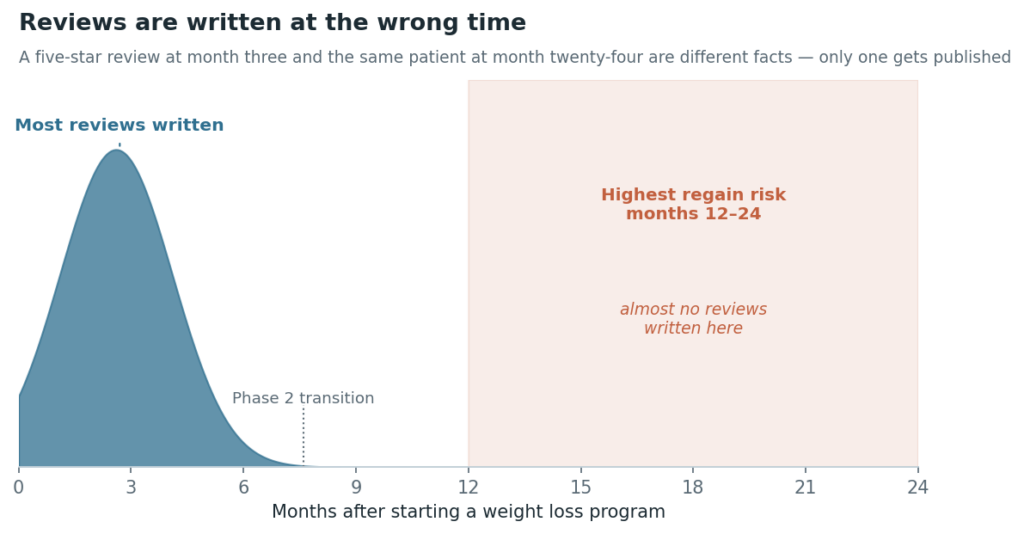
People write reviews when they feel something, and in weight loss that feeling peaks during active loss — the first few months, when the scale is moving fastest and the program feels transformative. The period that actually determines whether the program worked is one to two years later, and almost nobody goes back to update a review then.
That is not a small gap. The STEP 1 trial extension followed participants for a year after semaglutide was withdrawn and found they regained about two-thirds of their lost weight, with cardiometabolic improvements drifting back toward baseline. A five-star review written at month three and the same patient’s situation at month twenty-four can be entirely different facts, and only the first one is published.
Survivorship Bias, and Why the Denominator Is Missing
The second problem is the identity of the writer. Someone who enrolled, lost 40 pounds and felt supported the whole way is reasonably likely to leave a review. Someone who enrolled, found it unworkable and quit in week six is very unlikely to leave a review. Quitting rarely feels like a story worth publishing.
So the rating is calculated based on the reviews of the people a program retained. The number you would actually want (what share of people who started actually finished, and what share of those held their result) is missing from the denominator entirely. This is not a criticism of any particular clinic. It is a property of how public review systems work, and it applies to every program you are comparing, including the ones with the best scores.
Why No Program Can Honestly Call Itself “the Best”
You will see “best weight loss program” and “highest rated” used freely in this industry. It is worth understanding why those claims are close to meaningless here, because the reasoning also tells you what to look for instead.
A superlative about outcomes requires comparative outcome data, and that data mostly does not exist. When Johns Hopkins researchers systematically reviewed the evidence for major commercial weight-loss programs in Annals of Internal Medicine, they found long-term randomized evidence for only two — Weight Watchers and Jenny Craig — and noted that many trials were short, high-attrition and unblinded. For the vast majority of programs, including physician-run ones, no published trial exists that could support a claim of being better than the alternatives.
Medical advertising standards discourage outcome superlatives for exactly this reason, and any program that promises a guaranteed result is telling you how it handles evidence in general. The useful question is not “who is the best,” which is unanswerable, but “which one is structured for the outcome I want,” which is entirely answerable at a consultation.
How to Read Reviews Well
Getting real information out of a review page
What to do | Why |
Read three-star reviews first. | They tend to be the most specific and least emotional. Five-star and one-star reviews are usually about feelings; three-star reviews are usually about facts. |
Search the reviews for “maintenance,” “after,” and “kept it off.” | Reviews that mention what happened after goal weight are the rare ones carrying long-term signal. |
Weight recent reviews more heavily. | Staffing, ownership and protocols change. A glowing review from four years ago may describe a practice that no longer exists in that form. |
Look for repeated specifics, not the average. | Three separate reviewers describing the same billing problem is real information. A 4.8 average is not. |
Notice review clustering. | A burst of short, vague five-star reviews in one week is a pattern worth discounting. |
Ignore before-and-after photos entirely. | They show one person at one moment. They cannot indicate how typical the result was or whether it lasted. |
Four Things Worth More Than a Rating
Verified license status. Search the supervising physician at search.dca.ca.gov [https://search.dca.ca.gov/] for active California licensure and any public discipline. Free, and about a minute.
What gets measured. Body composition analysis separating fat mass from lean mass, re-measured over time — not scale weight alone. This is the difference between a program that can tell whether your loss is going well and one that cannot.
The visit schedule, in numbers. Ask how many appointments you will have in year one and compare it against the USPSTF 12-to-26-session benchmark.
Whether maintenance is included. A program that bills maintenance separately has made maintenance optional, and optional maintenance is the phase people skip. At Temkin Health, LeanMD’s Phase 2 transition runs three to five weeks and Phase 3 maintenance runs 12 months, both inside the program.
About Our Own Rating, and the Testimonials on This Site
It would be inconsistent to spend an article explaining the limits of ratings and then hide behind ours, so: Dr. Temkin’s Google Business Profile shows 4.6 stars across 358 reviews as of August 2026. Every caveat above applies to those numbers too. Those 358 reviews were written by people who chose to write; the ones who left without writing are not counted. Almost none were written two years after a weight loss program ended. The rating tells you something real about what it is like to be a patient here, and nothing at all about what you will weigh in 2028.
Temkin Health publishes patient testimonials, including video accounts from LeanMD patients, and they are subject to every limitation described above. They reflect the experiences of the individuals who shared them at the time they shared them. Results vary substantially with starting weight, medical conditions, coexisting medications and how closely a plan is followed, and no testimonial is a prediction of what will happen for you. We publish them because patient experience is genuine information, and we flag their limits because pretending otherwise would be the kind of claim this article argues against.
Frequently Asked Questions
Are weight loss program reviews reliable?
Reviews are reliable for what they measure and misleading for what people assume they measure. They capture the patient experience — whether staff were respectful, whether the plan was explained clearly, whether appointments ran on time — and those things matter. They do not capture long-term outcomes, because most reviews are written in the first few months, well before the period when weight regain typically occurs, and because people who dropped out rarely write anything at all.
Why can’t a weight loss program call itself the best?
Because there is no outcome measure that would support the claim. Very few programs publish long-term results at all; a systematic review in Annals of Internal Medicine found that among major commercial programs only Weight Watchers and Jenny Craig had randomized evidence at 12 months or longer. Without published comparative outcomes, superlatives in medical advertising describe marketing budgets rather than results, and many professional advertising standards discourage them for exactly that reason.
What should I look for in weight loss program reviews?
Read the three-star reviews first, because they usually contain the most specific information. Look for mentions of the maintenance phase, of what happened after the reviewer reached goal weight, and of whether they were still enrolled a year later. Consistent, specific complaints about billing, staff turnover or difficulty reaching the physician matter more than the overall score. A pattern of vague five-star reviews posted in a short window is a signal in itself.
Do before-and-after photos mean a program works?
They show that the program produced a result for the person shown, at the moment the photo was taken. They cannot show how typical that result was, how many people started and did not finish, or what the person weighed two years later. Under advertising standards, results shown in testimonials are not a guarantee of results for anyone else, which is why programs are expected to state that outcomes vary.
What is more useful than a star rating?
Four verifiable things: the supervising physician’s license status, checkable free at search.dca.ca.gov [https://search.dca.ca.gov/]; whether the program measures body composition rather than scale weight alone; the actual number of visits scheduled in the first year; and whether a maintenance phase is included rather than sold separately. Each one is a fact you can confirm at a consultation, and each predicts more about your result than any rating.
Ask the Four Questions
You can put all four to any program in a single phone call, including this one. Call Temkin Health at (925) 866-3900 or request a consultation online [https://drtemkin.com/contact-us/]. You are also welcome to read our patients’ accounts [https://drtemkin.com/testimonials/] with the caveats above in mind.
About Temkin Health
Temkin Health is a concierge internal medicine practice at 1081 Market Place, Suite 300, San Ramon, CA 94583, led by Dr. Michael Temkin, DO, a board-certified internal medicine physician with more than 25 years in private practice in San Ramon. The practice offers concierge primary care, the LeanMD medical weight loss program, bioidentical hormone replacement therapy for men and women, and longevity medicine. Phone: (925) 866-3900.
Related Reading
- How Do You Tell If a Weight Loss Program Is Actually Science-Backed? [https://drtemkin.com/blog/medical-weight-loss/science-backed-weight-loss-program-near-me/]
- What Weight Loss Programs Have Good Long Term Results? [https://drtemkin.com/blog/medical-weight-loss/what-weight-loss-programs-have-good-long-term-results/]
- What Is the Best Program for Weight Loss? [https://drtemkin.com/blog/medical-weight-loss/what-is-the-best-program-for-weight-loss/]
- How Do You Find a Doctor to Help With Weight Loss? [https://drtemkin.com/blog/medical-weight-loss/find-a-doctor-to-help-with-weight-loss/]
- What Are the Best Weight Loss Programs Near Me? A San Ramon and Tri-Valley Comparison [https://drtemkin.com/blog/medical-weight-loss/best-weight-loss-programs-near-me-san-ramon-tri-valley/]
Each of the above is part of Temkin Health’s San Ramon medical weight loss resource library.
Sources
- Gudzune KA, et al. Efficacy of commercial weight-loss programs: an updated systematic review. Annals of Internal Medicine. 2015;162(7). PubMed 25844997 [https://pubmed.ncbi.nlm.nih.gov/25844997/].
- Wilding JPH, et al. Weight regain and cardiometabolic effects after withdrawal of semaglutide: the STEP 1 trial extension. Diabetes, Obesity and Metabolism. 2022. PubMed 35441470 [https://pubmed.ncbi.nlm.nih.gov/35441470/].
- US Preventive Services Task Force. Weight Loss to Prevent Obesity-Related Morbidity and Mortality in Adults: Behavioral Interventions. [https://www.uspreventiveservicestaskforce.org/uspstf/recommendation/obesity-in-adults-interventions]
- Thomas JG, et al. Weight-loss maintenance for 10 years in the National Weight Control Registry. American Journal of Preventive Medicine. 2014. PubMed 24355667 [https://pubmed.ncbi.nlm.nih.gov/24355667/].
- Medical Board of California — license verification search [https://search.dca.ca.gov/].
Patient testimonials reflect individual experiences and are not a guarantee, warranty or prediction of the outcome of any other person’s care. Compounded drug products are not FDA-approved, which means the FDA does not evaluate compounded products for safety, effectiveness or quality. A LeanMD clinician may prescribe compounded or FDA-approved generic medications when medically necessary, based on a patient’s specific needs. Results may vary by patient; there are no guarantees, and outcomes depend on individual body composition, medical history and adherence. This article provides general health information and is not medical advice for any specific situation. Reading it does not create a doctor-patient relationship. Consult a licensed healthcare provider to discuss all treatment options, including potential risks and benefits.
Last updated August 2026.