
What Are the Best Weight Loss Programs Near Me in San Ramon and the Tri-Valley?
What Are the Best Weight Loss Programs Near Me in San Ramon and the Tri-Valley?
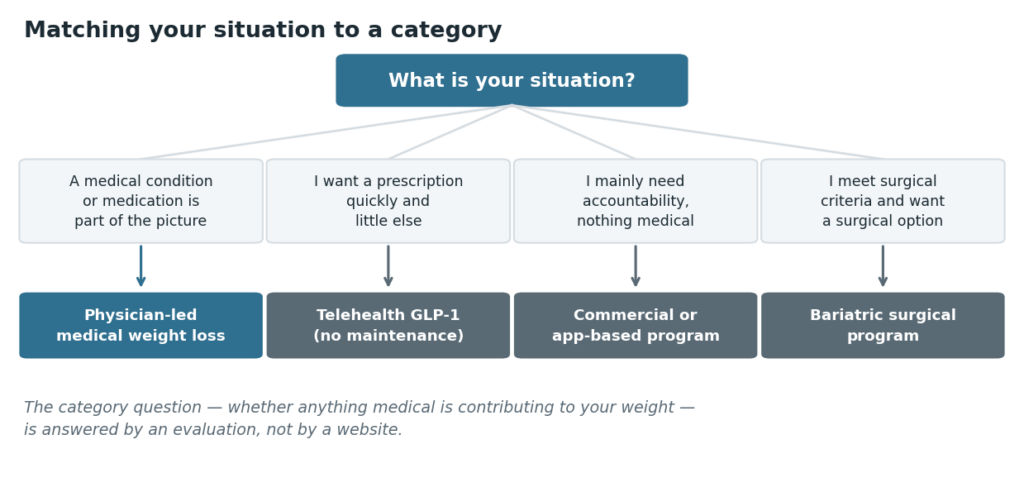
There is no single best weight loss program, and any program claiming to be one is making a claim no published data supports — but there are six distinct categories serving San Ramon and the Tri-Valley, and choosing the right category matters far more than choosing between clinics inside it. The deciding question is whether something medical is contributing to your weight.
Dr. Michael Temkin, DO, a board-certified internal medicine physician with more than 25 years in practice, runs the LeanMD medical weight loss program at Temkin Health, 1081 Market Place, Suite 300 in San Ramon — one of the physician-led options in category one below.
Key facts about weight loss options in the Tri-Valley
- Six categories serve this area, from telehealth prescribing to surgical programs, and they differ more from each other than clinics within a category differ.
- Comparative outcome data barely exists. A systematic review in Annals of Internal Medicine found long-term randomized evidence for only two major commercial programs (Gudzune et al., 2015 [https://pubmed.ncbi.nlm.nih.gov/25844997/]).
- Visit frequency is one of the few features with consistent evidence. The USPSTF [https://www.uspreventiveservicestaskforce.org/uspstf/recommendation/obesity-in-adults-interventions] found 12–26 sessions in year one produced about 6 percent weight loss versus 2.8 percent below 12 sessions.
- A prescription without a transition plan is a temporary result. Two-thirds of lost weight returned within a year of stopping semaglutide in the STEP 1 extension [https://pubmed.ncbi.nlm.nih.gov/35441470/].
- Drive time is a clinical variable here. Programs with weekly Phase 1 visits mean roughly 50 trips a year, so a 25-minute drive is a completion risk, not a preference.
- Three LeanMD provider practices operate in this corridor — Temkin Health and Diablo Family Physicians in San Ramon, and Golden State Orthopedics and Spine in Walnut Creek.
Why “Best” Is the Wrong Question
Weight loss advertising leans hard on superlatives, and the honest position is that they cannot be substantiated. When Johns Hopkins researchers reviewed the published evidence behind major commercial weight-loss programs for Annals of Internal Medicine, they found long-term randomized trial evidence for only two of them, and noted that many trials were short, high-attrition and unblinded. For most programs — including physician-run ones — no study exists that could establish one as better than another.
What the evidence does support is category-level reasoning. A program with a physician who can order labs and adjust your existing prescriptions is doing something structurally different from an app, and the difference matters enormously if a thyroid problem or a weight-promoting medication is part of your picture, and hardly at all if neither is. So the productive question is not “which is best” but “which category fits my situation, and which clinic inside it is set up well.”
The Six Categories, Compared
Weight loss program categories available to Tri-Valley residents
Category | What it does well | Main limitation | Best fit |
1. Physician-led medical weight loss | Labs, body composition, prescribing, comorbidity management and a maintenance phase under one physician. | Usually not billed to insurance; requires regular in-person visits. | Anyone with a coexisting condition, a weight-promoting medication, or a history of losing and regaining. |
2. Hospital-affiliated programs | Multidisciplinary teams, integration with specialty care, often insurance-billable. | Referral pathways and intake queues; less continuity with one clinician. | Complex medical histories, or anyone already inside that system. |
3. Integrated health-plan programs | Included in membership; records, pharmacy and labs already connected. | Program content and access vary; you generally see whoever is assigned. | Members who want to start without added cost. |
4. Telehealth GLP-1 services | Fast access to a prescription; no travel. | Typically no body composition measurement, no in-person exam, no maintenance phase or taper plan. | People who specifically want medication access and already have other clinical support. |
5. Commercial and app-based programs | Low cost, flexible, genuinely useful accountability and behavior tools. | No medical evaluation, no prescribing, cannot detect medical contributors. | People with no medical complications who mainly need structure. |
6. Bariatric surgical programs | The most durable weight loss of any option for those who qualify. Includes medical and nutritional evaluation. | Surgical risk; eligibility criteria; permanent anatomical change; extensive preparation. | People who meet criteria and want a surgical pathway. |
The Telehealth Question, Specifically
Telehealth GLP-1 services deserve a closer look because they have absorbed so much of this market so quickly, and because their strengths and weaknesses are both real.
The strength is access. If your goal is to start semaglutide or tirzepatide without a wait, these services do that efficiently, and for someone who already has a primary care physician managing the rest of their health, that can be a perfectly reasonable arrangement.
The limitation is what happens next. Most of these services do not measure body composition, so no one is tracking whether your loss is coming from fat or from muscle — a distinction that matters given that lean tissue has accounted for roughly 15 to 60 percent of total weight lost across GLP-1 trials. Most have no maintenance phase and no taper protocol. The STEP 1 extension is the relevant data point: a year after semaglutide was withdrawn, participants had regained about two-thirds of their loss, and that was in a trial where they were still receiving lifestyle support.
The question to ask any telehealth service is simply: what is your plan for when I stop? If there is not one, you are buying a result with an end date.
Getting Around the Tri-Valley: Why Drive Time Matters Clinically
This is not a soft factor. A medical program with weekly Phase 1 visits means roughly 50 trips over a year, and the USPSTF evidence is clear that attendance frequency tracks with results. A program 25 minutes away that you attend two-thirds of the time will likely underperform a program ten minutes away that you attend consistently.
From San Ramon, the practical radius is generous. Temkin Health is at 1081 Market Place, Suite 300, off Bollinger Canyon Road with direct I-680 access and across from the Market Place shopping center, less than a mile from San Ramon Regional Medical Center. That puts it inside a short drive of Danville and Alamo up Danville Boulevard, Blackhawk over Camino Tassajara, and Dublin and Pleasanton straight down 680, with Walnut Creek a quick run north. If you commute along the 680 corridor or work in Bishop Ranch, a visit fits into a lunch break rather than requiring a half day.
What to Ask, Whichever Category You Choose
Five questions work across all six categories and separate them faster than any comparison chart:
What do you measure at the first visit? Body composition and metabolic rate, or weight and BMI only.
How many visits will I have in the first year? Compare against the 12-to-26-session USPSTF benchmark.
Who is the supervising physician, and can I look them up? California license status is public at search.dca.ca.gov [https://search.dca.ca.gov/].
What happens after I reach my goal weight? A named phase with a stated length, or nothing.
Do I have to buy food, shakes or supplements from you? If yes, the result lasts as long as the purchases do.
Where LeanMD at Temkin Health Sits
LeanMD is a category-one option: physician-led, in person, with a maintenance phase built into the program. Dr. Temkin supervises patients directly through all three phases. The first visit produces body composition analysis, vital signs and basal metabolic rate assessment, and the calorie and protein targets follow from those numbers. Phase 1 runs 2 to 12 months, Phase 2 is a three-to-five-week structured transition with any medication tapered rather than stopped, and Phase 3 runs 12 months of maintenance.
One overlap between categories one and two is worth knowing: Dr. Temkin holds hospital affiliations at San Ramon Regional Medical Center and John Muir Medical Center’s Walnut Creek campus. Choosing an independent practice here does not mean stepping outside the local hospital systems — if you are admitted at either, the physician managing your weight is inside the same system rather than an outside provider your hospital team has never dealt with.
Two things it is not: it is not billed to insurance, and it is not the right fit for someone who wants a prescription with no appointments. No food, shakes or supplements are sold to patients. Weekly and monthly payment options are both available, and a flexible track allows a mix of in-office and virtual visits using a wireless e-scale.
Frequently Asked Questions
What weight loss options are available near San Ramon, California?
Tri-Valley residents can reach six categories of program within roughly a fifteen-minute drive: physician-led medical weight loss in independent practices, hospital-affiliated programs through systems including John Muir Health, San Ramon Regional Medical Center and Stanford Health Care Tri-Valley, integrated health-plan programs for Kaiser Permanente members, telehealth GLP-1 prescribing services, commercial and app-based programs, and surgical bariatric programs. They differ in medical oversight, visit frequency and whether maintenance is included.
Which type of weight loss program is best?
There is no single best type, and no program can honestly claim to be one, because published comparative long-term outcome data barely exists. The right category depends on your situation. If a medical condition or a current medication is contributing to your weight, you need physician involvement. If you mainly need accountability and have no medical complications, a commercial or app-based program may be sufficient. If you meet surgical criteria and want a durable surgical option, a bariatric program is a different pathway entirely.
Are telehealth GLP-1 programs a good option?
They are fast and convenient for getting a prescription, and that is genuinely useful for some people. The limitation is structural: most do not measure body composition, do not see you in person, and have no maintenance phase or taper plan. In the STEP 1 trial extension, participants regained about two-thirds of their lost weight in the year after semaglutide was withdrawn, which is the scenario a service with no transition structure leaves you to manage alone. Ask any telehealth service what happens when you stop.
Does insurance cover weight loss programs in California?
Coverage varies widely by plan and by what is being billed. Many independent medical weight loss programs, including LeanMD at Temkin Health, do not bill insurance for the weight loss program itself. Some medications may be covered under a pharmacy benefit depending on the plan and the diagnosis, and hospital-affiliated and surgical programs are more often billed through insurance. Check directly with your plan, and ask each program what it does and does not bill.
How far do people travel for medical weight loss in the Tri-Valley?
Most people stay within about fifteen minutes, which in this area covers a lot of ground. From 1081 Market Place in San Ramon, off Bollinger Canyon Road with direct I-680 access, that radius includes Danville, Alamo, Blackhawk, Dublin, Pleasanton and much of Walnut Creek. Because programs with weekly Phase 1 visits require frequent trips, drive time is a practical factor in whether you complete a program rather than a minor convenience.
Start With a Consultation
The category question — whether something medical is contributing to your weight — is answered by an evaluation, not by a website. To discuss it with Dr. Temkin, call Temkin Health at (925) 866-3900 or request a consultation online [https://drtemkin.com/contact-us/].
About Temkin Health
Temkin Health is a concierge internal medicine practice at 1081 Market Place, Suite 300, San Ramon, CA 94583, led by Dr. Michael Temkin, DO, a board-certified internal medicine physician with more than 25 years in private practice in San Ramon. The practice offers concierge primary care, the LeanMD medical weight loss program, bioidentical hormone replacement therapy for men and women, and longevity medicine. Phone: (925) 866-3900.
Related Reading
- What Is the Best Program for Weight Loss? [https://drtemkin.com/blog/medical-weight-loss/what-is-the-best-program-for-weight-loss/]
- How Do You Find a Sustainable Weight Loss Clinic Near You? [https://drtemkin.com/blog/medical-weight-loss/sustainable-weight-loss-clinic-near-me/]
- How Do You Find a Doctor to Help With Weight Loss? [https://drtemkin.com/blog/medical-weight-loss/find-a-doctor-to-help-with-weight-loss/]
- How Do You Tell If a Weight Loss Program Is Actually Science-Backed? [https://drtemkin.com/blog/medical-weight-loss/science-backed-weight-loss-program-near-me/]
- What Is LeanMD? Who Runs It and How the Program Works [https://drtemkin.com/blog/medical-weight-loss/what-is-leanmd-and-how-the-program-works/]
Each of the above is part of Temkin Health’s San Ramon medical weight loss resource library.
Sources
- Gudzune KA, et al. Efficacy of commercial weight-loss programs: an updated systematic review. Annals of Internal Medicine. 2015;162(7). PubMed 25844997 [https://pubmed.ncbi.nlm.nih.gov/25844997/].
- US Preventive Services Task Force. Weight Loss to Prevent Obesity-Related Morbidity and Mortality in Adults: Behavioral Interventions. [https://www.uspreventiveservicestaskforce.org/uspstf/recommendation/obesity-in-adults-interventions]
- Wilding JPH, et al. Weight regain and cardiometabolic effects after withdrawal of semaglutide: the STEP 1 trial extension. Diabetes, Obesity and Metabolism. 2022. PubMed 35441470 [https://pubmed.ncbi.nlm.nih.gov/35441470/].
- Neeland IJ, et al. Changes in lean body mass with glucagon-like peptide-1-based therapies and mitigation strategies. Diabetes, Obesity and Metabolism. 2024. doi:10.1111/dom.15728 [https://dom-pubs.onlinelibrary.wiley.com/doi/10.1111/dom.15728].
- Medical Board of California — license verification search [https://search.dca.ca.gov/].
- LeanMD — Find a Doctor [https://leanmd.com/find-a-doctor/]; Temkin Health — LeanMD in San Ramon [https://drtemkin.com/leanmd/].
Local facilities and health systems are named to describe the categories of care available in the Tri-Valley area, and nothing here should be read as a comparison of their outcomes, pricing or quality. Dr. Temkin holds hospital affiliations at San Ramon Regional Medical Center and John Muir Medical Center’s Walnut Creek campus; those affiliations are admitting relationships and do not mean Temkin Health operates, endorses or is endorsed by any weight loss program run by those systems. Compounded drug products are not FDA-approved, which means the FDA does not evaluate compounded products for safety, effectiveness or quality. A LeanMD clinician may prescribe compounded or FDA-approved generic medications when medically necessary, based on a patient’s specific needs. Results may vary by patient; there are no guarantees, and outcomes depend on individual body composition, medical history and adherence. This article provides general health information and is not medical advice for any specific situation. Reading it does not create a doctor-patient relationship. Consult a licensed healthcare provider to discuss all treatment options, including potential risks and benefits.
Last updated August 2026.