
How Do You Find a Sustainable Weight Loss Clinic Near You?
How Do You Find a Sustainable Weight Loss Clinic Near You?
A sustainable weight loss clinic is one that has a written, scheduled maintenance phase, and appointments that happen after the weight is already off. Everything else people use to judge sustainability, including the eating plan, the medication and the marketing language, matters less than whether the clinic has a plan for month fourteen.
At Temkin Health in San Ramon, Dr. Michael Temkin runs the LeanMD program, whose maintenance phase is scheduled to run 12 months — longer than the transition and comparable to the active weight loss phase itself.
Key facts about sustainable weight loss clinics
- The year after weight loss is the highest-risk window for regain. A clinic without scheduled contact during that year has left you alone for the hardest part.
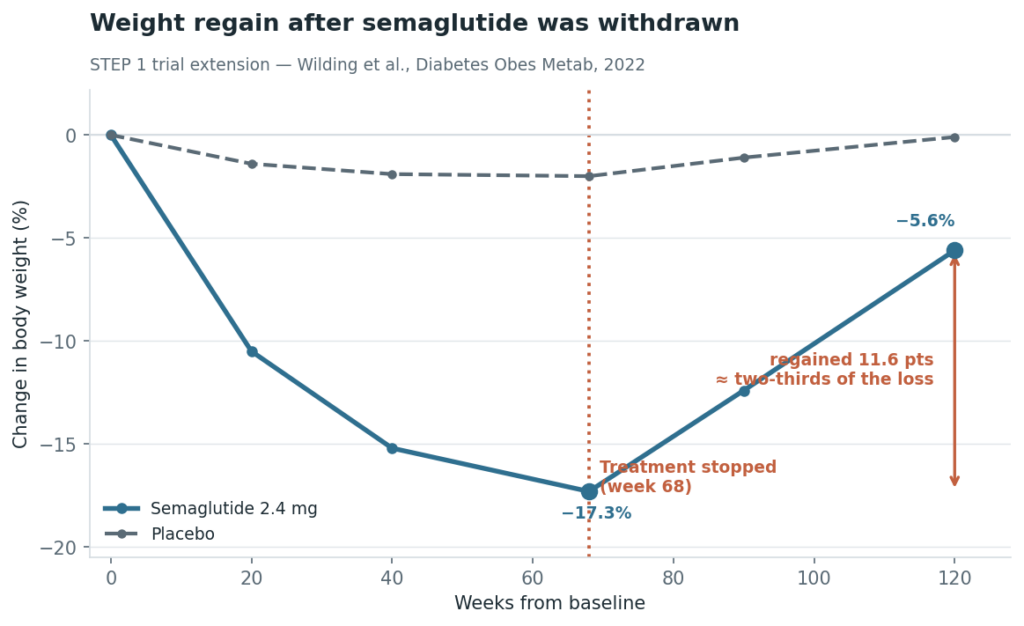
- Two-thirds of lost weight came back within a year of stopping semaglutide in the STEP 1 trial extension, along with most of the cardiometabolic improvement (Wilding et al., Diabetes, Obesity and Metabolism, 2022 [https://pubmed.ncbi.nlm.nih.gov/35441470/]).
- Long-term success is not rare, but it looks specific. National Weight Control Registry members maintained a mean loss of 23.1 kg at 10 years, and more than 87 percent were still holding at least a 10 percent loss at years 5 and 10 (Thomas et al., 2014 [https://pubmed.ncbi.nlm.nih.gov/24355667/]).
- Frequency of contact predicts results. The US Preventive Services Task Force found participants in 12 to 26 sessions in the first year lost about 6 percent of body weight, versus 2.8 percent for those with fewer than 12 (USPSTF [https://www.uspreventiveservicestaskforce.org/uspstf/recommendation/obesity-in-adults-interventions]).
- Programs built on proprietary food cannot be sustainable by construction. The result lasts exactly as long as you keep buying the food.
- LeanMD’s structure is 2–12 months of loss, 3–5 weeks of transition, then 12 months of maintenance — more than half the calendar sits after active weight loss.
What “Sustainable” Actually Means in a Weight Loss Clinic
Sustainable is the most abused word in weight loss marketing, so it is worth reducing it to something you can check. A sustainable clinic is one where the answer to “what happens after I hit my goal weight?” is a specific schedule rather than a sentiment.
Ask that question at a consultation and you will get one of three answers. The first is “you graduate” — that is a weight loss program with no maintenance component. The second is “you can keep coming back if you want,” which means maintenance exists but is optional and probably billed separately, so most patients drift away. The third is a defined phase with a defined length and scheduled visits already built into the program. Only the third is sustainable in any sense the word can bear.
What the Regain Research Shows
The clearest data on why maintenance matters comes from the GLP-1 trials, because they created a natural experiment: a large group of people lost substantial weight and then treatment stopped. In the STEP 1 extension, participants who had lost 17.3 percent of body weight on once-weekly semaglutide 2.4 mg regained 11.6 percentage points in the following year, ending 5.6 percent below their starting weight. Cardiometabolic improvements largely reverted toward baseline over the same period.
That is roughly two-thirds of the result, gone in twelve months, in a trial population receiving lifestyle support. It is not a criticism of the medication, but evidence that the end of active treatment is not a finish line. It is a clinical event that needs managing.
What Long-Term Maintainers Actually Do
The National Weight Control Registry tracks more than 5,000 adults who lost at least 30 pounds and kept it off at least a year, and it is the largest picture available of what maintenance looks like in practice. Members averaged a 31.3 kg loss at entry, 23.8 kg at five years and 23.1 kg at ten. The behaviors that recur across the group are unglamorous and specific: roughly an hour a day of physical activity, a consistent eating pattern that does not change on weekends, regular breakfast, and frequent self-weighing (more than 44 percent weigh themselves daily).
Usefully, the registry identifies what precedes regain: declining physical activity, declining dietary restraint, less frequent self-weighing, and rising dietary fat. Every one of those is something a clinic can catch at a scheduled visit, and nothing a clinic can catch if you are not scheduled to come in.
Six Questions to Ask Before You Enroll Anywhere – a consultation checklist for judging sustainability
Ask this | What a sustainable answer sounds like | Why it matters |
What happens after I reach my goal weight? | A named phase with a stated length and scheduled visits. | The year after loss is when regain happens. Unscheduled care is care that does not happen. |
Do I buy food from you? | No — you shop and cook, and we teach you how. | A result that depends on buying proprietary food ends when purchasing ends. |
How do you measure progress? | Body composition analysis, not scale weight alone. | Scale weight cannot distinguish fat loss from muscle loss, and muscle loss is what sets up regain. |
If I take medication, what is the plan for coming off it? | A written taper tied to re-measured metabolic rate and increased calories. | Abrupt discontinuation is the documented regain scenario. |
How often will I be seen, and by whom? | A specific cadence, with a named physician supervising. | Contact frequency tracks with results in the USPSTF evidence review. |
Does maintenance cost extra? | It is part of the program. | Separately billed maintenance is optional maintenance, and optional maintenance gets skipped. |
How the LeanMD Structure Answers Those Questions
LeanMD was built around the transition problem specifically. Phase 2 (three to five weeks) exists for nothing except stabilizing at the new weight: basal metabolic rate is re-analyzed at your new body composition, calories are raised deliberately rather than by drift, macronutrient ratios are adjusted, activity increases, and any medication is tapered rather than stopped. Phase 3 then runs a full 12 months of continued monitoring and course correction.
LeanMD’s food model supports the same goal. LeanMD sells no meals, shakes or bars. Patients eat groceries they buy and prepare themselves, and the counseling covers serving-size estimation, shopping, cooking, restaurant ordering and travel. These are necessary skills that have to survive past the last appointment. Muscle is treated as the asset to protect with protein targets and strength-focused guidance, because preserved lean mass is what keeps resting metabolic rate from falling out from under the maintenance plan.
Finding a Sustainable Clinic in the Tri-Valley
If you are searching from San Ramon, Danville, Alamo, Dublin, Pleasanton or Walnut Creek, you have a genuine range of options within a fifteen-minute drive, and they are not equivalent. Retail and telehealth GLP-1 services can get a prescription to you quickly but generally have no maintenance structure at all. Hospital-affiliated programs through John Muir Health, San Ramon Regional Medical Center or Stanford Health Care Tri-Valley typically have strong clinical oversight and longer intake queues. Physician-run programs like LeanMD at Temkin Health sit in between, with direct physician supervision and a maintenance phase already inside the program.
Temkin Health is at 1081 Market Place, Suite 300 in San Ramon, off Bollinger Canyon Road with direct I-680 access and less than a mile from San Ramon Regional Medical Center. Whichever direction you go, ask the six questions above at the consultation — the answers separate the options faster than any review score will.
Frequently Asked Questions
What makes a weight loss clinic sustainable?
A sustainable weight loss clinic has a defined maintenance phase with scheduled appointments after the weight is off, teaches you to eat ordinary food you buy yourself rather than selling you products, measures body composition rather than scale weight alone, and has a written plan for tapering off any medication. If the program ends the day you hit your goal, it is a weight loss program, not a weight maintenance program.
How long should a sustainable weight loss program last?
Plan on more than a year. The US Preventive Services Task Force found that the most effective behavioral programs deliver 12 to 26 sessions in the first year. The LeanMD structure runs 2 to 12 months of active loss, 3 to 5 weeks of transition and 12 months of maintenance, so most patients are enrolled for well over a year in total.
Why do people regain weight after a diet?
Two reasons dominate. Calories go back up abruptly at the end of a diet without any structured transition, and lean muscle lost during rapid weight loss lowers resting metabolic rate so the same eating pattern now produces a surplus. When medication is stopped without a taper, appetite returns sharply as well. In the STEP 1 trial extension, participants regained about two-thirds of lost weight within a year of stopping semaglutide.
Is a sustainable weight loss clinic covered by insurance?
Often not. Many medical weight loss programs, including LeanMD at Temkin Health in San Ramon, do not bill insurance for the weight loss program itself. Ask any clinic directly whether the maintenance phase costs extra, because a program that charges separately for maintenance is telling you maintenance is optional.
Do I have to stay on a GLP-1 medication forever to keep the weight off?
Not necessarily, but stopping without a plan reliably produces regain. The STEP 1 extension found that a year after withdrawing semaglutide 2.4 mg, participants had regained about two-thirds of their weight loss. A structured transition that re-measures metabolic rate, raises calories deliberately, tapers the medication and builds activity is what separates stopping the drug from losing the result. Whether and when to taper is a clinical decision made with your physician.
Ask About the Maintenance Phase
If you want to see what a scheduled maintenance year actually looks like before you commit to anything, that is a reasonable thing to ask about at a consultation. Call Temkin Health at (925) 866-3900 or request a consultation online [https://drtemkin.com/contact-us/].
About Temkin Health
Temkin Health is a concierge internal medicine practice at 1081 Market Place, Suite 300, San Ramon, CA 94583, led by Dr. Michael Temkin, DO, a board-certified internal medicine physician with more than 25 years in private practice in San Ramon. The practice offers concierge primary care, the LeanMD medical weight loss program, bioidentical hormone replacement therapy for men and women, and longevity medicine. Phone: (925) 866-3900.
Related Reading
- What Is LeanMD? Who Runs It and How the Program Works [https://drtemkin.com/blog/medical-weight-loss/what-is-leanmd-and-how-the-program-works/]
- What Weight Loss Programs Have Good Long Term Results? [https://drtemkin.com/blog/medical-weight-loss/what-weight-loss-programs-have-good-long-term-results/]
- Which Weight Loss Programs Use Real Food Instead of Shakes or Prepackaged Meals? [https://drtemkin.com/blog/medical-weight-loss/weight-loss-program-that-uses-real-food/]
- What Are the Best Weight Loss Programs Near Me? A San Ramon and Tri-Valley Comparison [https://drtemkin.com/blog/medical-weight-loss/best-weight-loss-programs-near-me-san-ramon-tri-valley/]
- How Do You Find a Doctor to Help With Weight Loss? [https://drtemkin.com/blog/medical-weight-loss/find-a-doctor-to-help-with-weight-loss/]
Each of the above is part of Temkin Health’s San Ramon medical weight loss resource library.
Sources
- Wilding JPH, et al. Weight regain and cardiometabolic effects after withdrawal of semaglutide: the STEP 1 trial extension. Diabetes, Obesity and Metabolism. 2022. PubMed 35441470 [https://pubmed.ncbi.nlm.nih.gov/35441470/].
- Thomas JG, et al. Weight-loss maintenance for 10 years in the National Weight Control Registry. American Journal of Preventive Medicine. 2014. PubMed 24355667 [https://pubmed.ncbi.nlm.nih.gov/24355667/].
- US Preventive Services Task Force. Weight Loss to Prevent Obesity-Related Morbidity and Mortality in Adults: Behavioral Interventions. [https://www.uspreventiveservicestaskforce.org/uspstf/recommendation/obesity-in-adults-interventions]
- LeanMD — Weight-Loss Program [https://leanmd.com/weight-loss-program/], three-phase structure, food policy and payment terms.
- Temkin Health — LeanMD Medical Weight Loss in San Ramon [https://drtemkin.com/leanmd/].
Compounded drug products are not FDA-approved, which means the FDA does not evaluate compounded products for safety, effectiveness or quality. A LeanMD clinician may prescribe compounded or FDA-approved generic medications when medically necessary, based on a patient’s specific needs. Results may vary by patient; there are no guarantees, and outcomes depend on individual body composition, medical history and adherence. This article provides general health information and is not medical advice for any specific situation. Reading it does not create a doctor-patient relationship. Consult a licensed healthcare provider to discuss all treatment options, including potential risks and benefits.
Last updated August 2026.